Why the Bond Market Still Matters
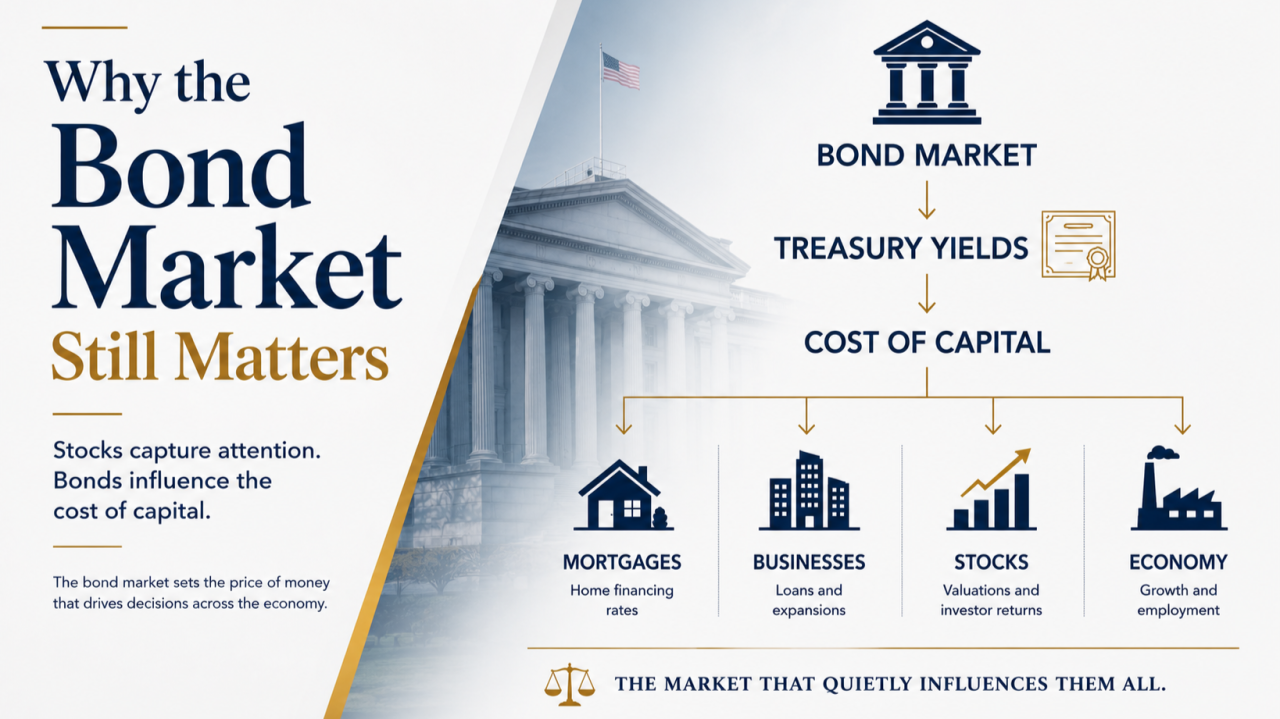
Most people follow the stock market.
Institutional investors often begin with the bond market.
That isn't because bonds are more exciting.
It's because bonds help determine something that affects almost every financial decision in the economy:
The cost of money.
Whether you're buying a home, expanding a business, financing a factory, or valuing a company, the bond market quietly influences the numbers behind the decision.
It rarely makes headlines.
But it shapes the environment every investor operates in.
The Market That Prices Capital
Imagine you're considering opening a second location for your business.
The first question probably isn't whether demand exists.
It's whether you can finance the expansion at an attractive cost.
If borrowing is inexpensive, the project may make perfect sense.
If interest rates suddenly double, the exact same project may no longer work.
Nothing changed about the opportunity.
The cost of capital changed.
The bond market performs that same function for the global economy.
Every day, governments and companies borrow money through bonds.
The interest rates investors demand become the foundation for mortgages, business loans, corporate financing, and countless other borrowing decisions.
In many ways, the bond market sets the price of money.
Bigger Than Most People Realize
Many investors are surprised to learn that the global bond market is actually larger than the global stock market.
Stocks represent ownership.
Bonds represent financing.
And before businesses can grow, governments can invest, or homeowners can buy property, someone usually has to provide the capital.
That makes the bond market one of the most important plumbing systems in the global financial system.
Most people never see it.
Everyone depends on it.
Why Bond Yields Matter
One of the most important numbers in finance is the yield on U.S. Treasury securities.
Think of it as the baseline cost of borrowing.
If Treasury yields rise, lenders typically demand higher returns elsewhere too.
Mortgage rates often increase.
Business loans become more expensive.
Corporate borrowing costs rise.
Even stock valuations can decline because future profits become less valuable when investors have higher-risk-free alternatives.
One market quietly influences many others.
Why Professionals Watch Bonds First
Institutional investors also pay attention to bonds because they often react to changing economic conditions before stocks do.
Bond investors spend their time evaluating inflation, interest rates, credit quality, and economic growth.
When those expectations change, bond prices and yields often adjust quickly.
History offers several examples.
Before the 2020 recession, credit markets began showing signs of stress before many equity investors appreciated the scale of the disruption.
During the inflation surge that followed, Treasury yields climbed well before many businesses fully recognized how dramatically financing conditions were changing.
The bond market isn't perfect.
But it often provides an early read on how investors view the broader economy.
Why This Matters Beyond Investing
You don't need to own a single bond for the bond market to affect your life.
If you're applying for a mortgage...
Financing a commercial building...
Expanding your business...
Or investing for retirement...
You're operating in an environment shaped, in part, by bond yields.
Understanding bonds isn't about becoming a fixed-income expert.
It's about understanding how money moves through the economy.
The Bigger Lesson
Stocks often receive the attention because they're visible.
The bond market quietly does something even more important.
It helps determine the cost of capital that influences businesses, consumers, governments, and investors alike.
That's why institutional investors spend so much time watching it.
Because before capital can grow...
It has to be priced.
And that's exactly what the bond market does.