Why Data Centers Became Strategic Infrastructure
Why Data Centers Became Strategic Infrastructure
Everyone is talking about artificial intelligence.
New models.
Smarter software.
Bigger capabilities.
But when I listen to conversations among institutional investors, infrastructure specialists, and utility executives, the discussion usually goes in a different direction.
They aren't asking:
"What can AI do next?"
They're asking:
"Where will all the electricity come from?"
That simple question changes how you see the entire AI story.
Because AI isn't just a software revolution.
It's becoming one of the largest infrastructure buildouts we've seen in decades.
Every Revolution Needs Infrastructure History follows a familiar pattern.
The Industrial Revolution wasn't just about factories.
It required railroads to move goods.
Power plants to generate electricity.
Ports to support trade.
The internet wasn't just websites.
It required fiber-optic cables, wireless towers, and massive telecommunications networks.
AI is following exactly the same path.
The software captures the headlines.
The infrastructure makes the software possible.
The Factory Behind Artificial Intelligence Imagine building the world's most advanced factory...
...but forgetting to connect it to electricity.
It wouldn't matter how efficient the machines were.
Nothing would operate.
AI works the same way.
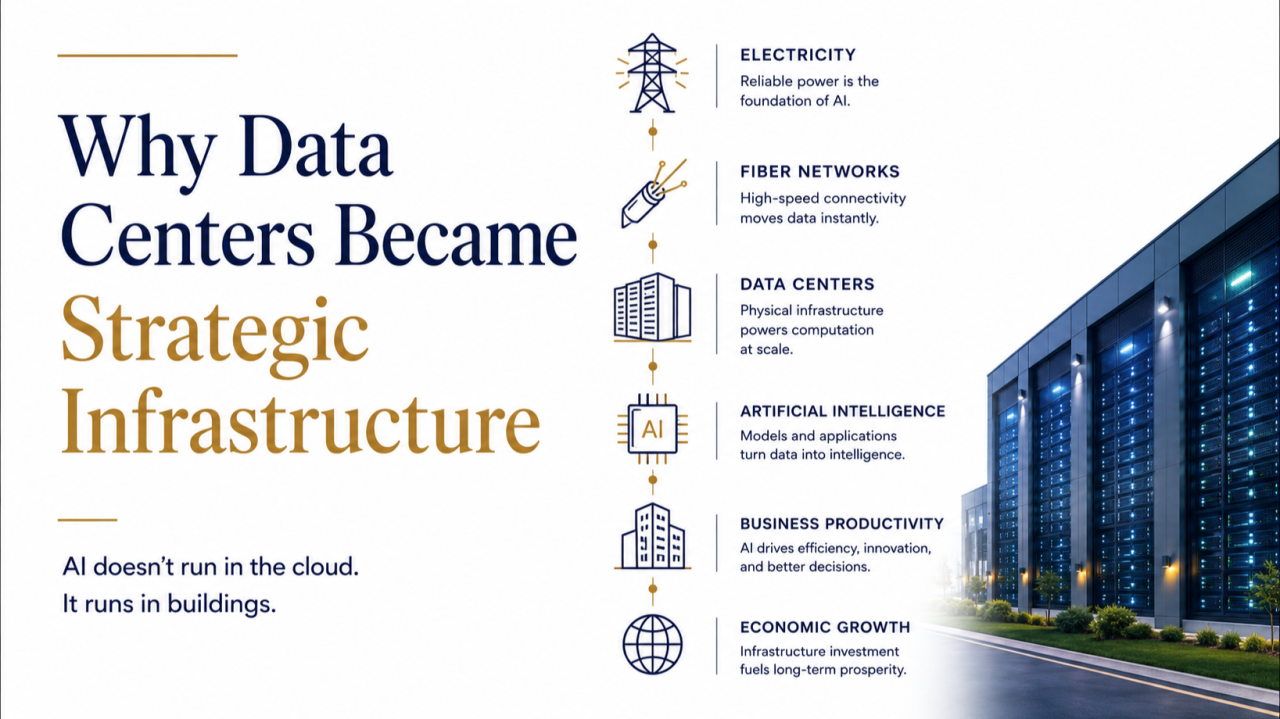
Every question you ask an AI model is processed inside a physical building filled with thousands of specialized computer chips.
Those buildings require enormous amounts of:
Electricity Cooling systems High-speed fiber connections Reliable land and utility infrastructure
Without them, AI simply doesn't run.
Why Data Centers Are Suddenly So Valuable Traditional cloud computing required data centers.
Artificial intelligence requires an entirely different scale.
Today's AI models demand significantly more computing power, consume far more electricity, and generate substantially more heat than previous generations of software.
Industry estimates suggest global demand for AI-related data center capacity could nearly triple by the end of the decade, requiring trillions of dollars of investment.
That's not simply technology spending.
It's infrastructure spending.
The New Scarce Resources One of the biggest surprises in today's AI boom isn't a shortage of software engineers.
It's a shortage of power.
Many developers can build another data center.
Far fewer can secure enough electricity to operate it.
That's why conversations increasingly revolve around:
power generation, transmission lines, cooling technology, water availability, and fiber connectivity.
In many markets, access to electricity (not land), is becoming the biggest constraint.
In other words, AI is creating demand for assets most people rarely associate with technology.
Why Institutional Investors Are Paying Attention This is one reason firms like BlackRock, Brookfield, JPMorgan, and Goldman Sachs increasingly describe AI as an infrastructure theme rather than simply a technology theme.
They're looking beyond software companies.
They're asking:
Who owns the power?
Who builds the facilities?
Who supplies the electrical equipment?
Who finances the infrastructure?
Those questions may ultimately matter just as much as who builds the next AI model.
Governments are asking similar questions.
Just as countries once viewed railroads, highways, and electrical grids as strategic assets, many now see domestic data center capacity as critical to long-term economic competitiveness.
The Bigger Investment Story Artificial intelligence will continue generating headlines.
New models will become smarter.
Applications will become more capable.
But none of it happens without the physical infrastructure underneath.
The next time someone says AI is transforming the economy, remember this:
Software may be the product we interact with.
Infrastructure is what makes the entire system possible.
Because every technological revolution eventually depends on something surprisingly ordinary.
Reliable buildings.
Reliable electricity.
Reliable networks.
The future of AI may be digital.
But its foundation is unmistakably physical.