Why Central Banks Watch Financial Conditions Closely
Why Central Banks Watch Financial Conditions Closely
When most people hear about the Federal Reserve, they immediately think about one thing:
Interest rates.
Rates go up, borrowing becomes more expensive. Rates go down, borrowing gets easier.
Simple.
Except that isn't how the real economy works.
In fact, one of the biggest mistakes investors make is assuming the Fed is only watching interest rates.
It isn't.
The Fed is watching something much bigger: Financial Conditions.
Financial Conditions Are the Economy's Operating Environment Think of running a business.
You wouldn't decide whether to hire employees, expand into a new location, or invest in equipment based on one number alone.
You'd consider:
Can I get a loan? How expensive is financing? Are customers still spending? Are banks willing to lend? Is confidence improving or deteriorating?
That's exactly how central banks think.
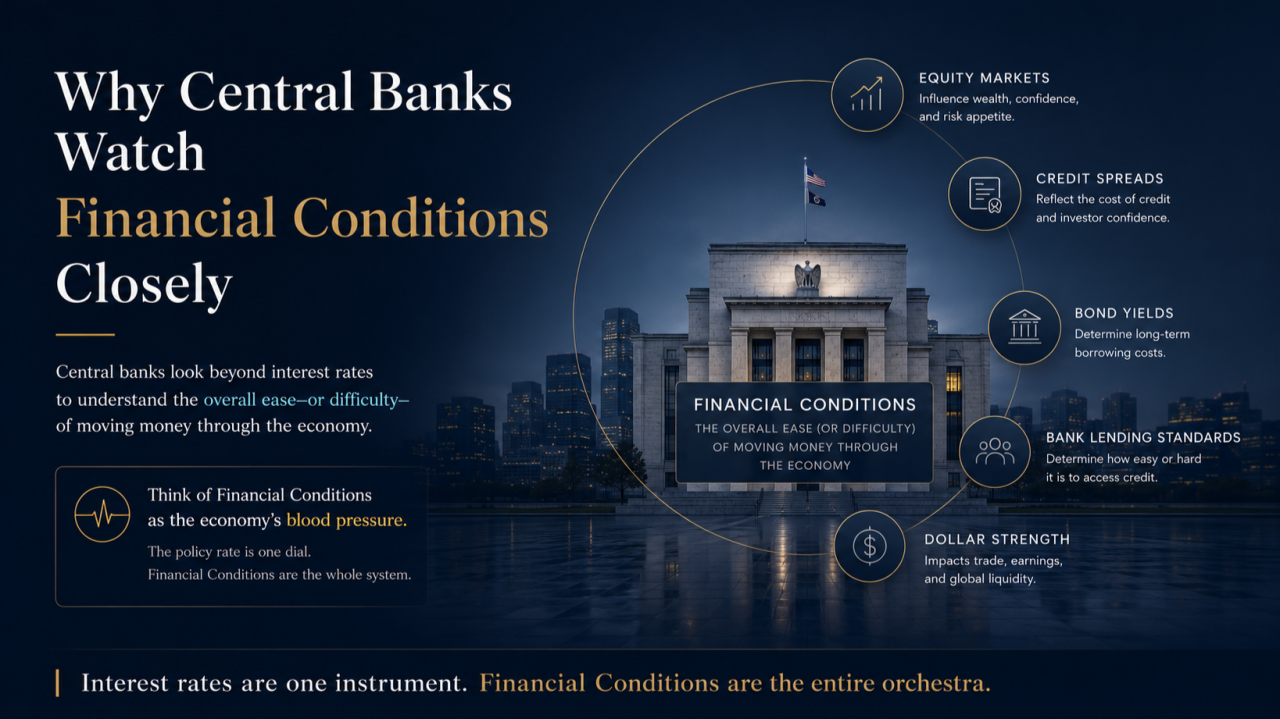
Financial Conditions describe the overall ease, or difficulty, of moving money through the economy.
Interest rates are part of that picture.
But so are credit spreads, stock prices, long-term bond yields, bank lending standards, and even the strength of the U.S. dollar.
In other words:
Interest rates are one instrument. Financial Conditions are the entire orchestra.
Why the Fed Cares About More Than Rates Here's something that surprises many investors.
The Fed can raise interest rates...
...and Financial Conditions can actually become easier.
How?
Imagine investors become more optimistic.
Stock prices rise.
Credit becomes easier to obtain.
Banks continue lending aggressively.
Corporate borrowing costs fall.
Even with a higher policy rate, businesses may still find it attractive to invest and expand.
The opposite can happen too.
The Fed doesn't change rates at all...
...yet banks tighten lending standards, investors demand higher compensation for risk, and companies suddenly find financing much more expensive.
Nothing changed in the Fed's announcement.
Everything changed in the real economy.
That's why professional investors spend as much time watching Financial Conditions as they do Fed meetings.
Why This Matters to Business Owners Think about your own business.
Suppose you're considering opening a second location.
The decision isn't based solely on today's interest rate.
It's based on whether the bank approves your loan.
Whether customers are still spending.
Whether investors remain confident.
Whether financing is available on reasonable terms.
Those factors together determine whether expansion makes sense.
Central banks evaluate the economy the same way.
They're not asking:
"Where is one interest rate?"
They're asking:
"How easy is it for households and businesses to access capital?"
Watching the System, Not the Headline One of the simplest ways to think about Financial Conditions is to imagine the economy as the human body.
Interest rates are like adjusting one control.
Financial Conditions are the body's overall health.
A doctor wouldn't judge your health from one number alone.
Neither does the Federal Reserve.
It looks at how the entire system is functioning.
Because ultimately, monetary policy only works if it changes behavior.
If businesses continue borrowing, consumers continue spending, and markets remain highly accommodative, policy may not be having the intended effect.
Conversely, if credit becomes scarce and confidence weakens, Financial Conditions can tighten even without another rate hike.
The Bigger Picture The next time the Fed announces a policy decision, pay attention to the headline.
Then look one layer deeper.
Ask yourself:
Are banks becoming more willing to lend? Are companies finding it easier or harder to raise capital? Are investors taking more or less risk? Is financing becoming more accessible across the economy?
Those questions often tell a much richer story than the policy rate itself.
Because sophisticated investors don't just watch what the Fed says.
They watch how Financial Conditions shape the entire economy.
And that's often where the real story begins.