When Tactical Positioning May Make Sense
There’s a common misconception about long-term investing:
That discipline means never changing the portfolio.
Set the allocation.
Walk away.
Check back in ten years.
That sounds disciplined.
But it isn’t how institutional investors actually manage capital.
They usually build portfolios around a long-term structure, then make selective adjustments when the balance of risk and opportunity changes enough to matter.
The important part is knowing the difference between strategy, maintenance, and adaptation.
Three Different Decisions
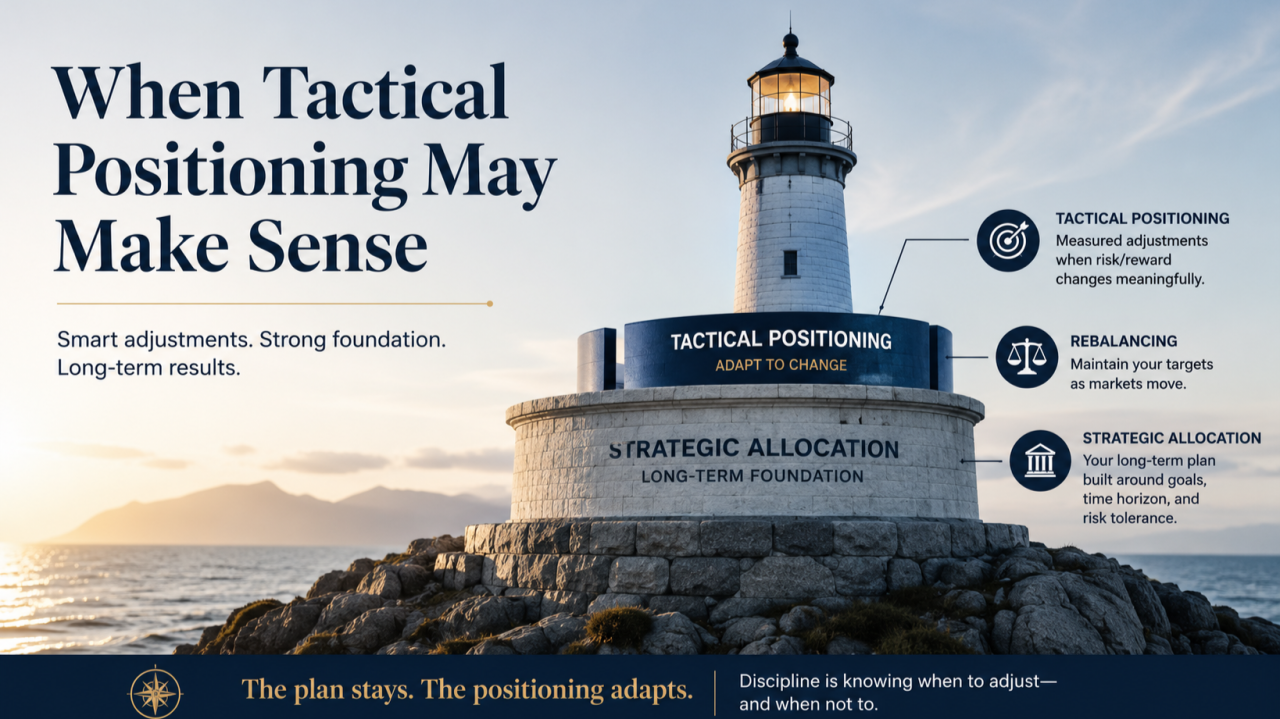
Think of a portfolio in three layers.
Strategic allocation is the long-term architecture.
It reflects your goals, time horizon, liquidity needs, and tolerance for risk.
That foundation should change rarely.
Rebalancing is maintenance.
If market moves push the portfolio away from its intended weights, rebalancing brings it back.
No forecast required.
Tactical positioning is different.
It is a deliberate, measured adjustment because the investment environment has changed in a meaningful way.
That distinction matters.
Because tactical positioning is not the same thing as market timing.
What Tactical Positioning Is Not
It is not reacting to headlines.
It is not chasing last year’s winner.
It is not moving entirely into cash because markets feel uncomfortable.
And it is not trying to predict every market turn.
That is speculation.
Tactical positioning is much more restrained.
It asks:
Has something changed enough to justify a modest adjustment?
Think Like a Business Owner
Imagine running a business with a five-year strategic plan.
You wouldn’t rewrite that plan because one quarter was disappointing.
But suppose borrowing costs doubled.
Customer demand changed materially.
Or a major competitor suddenly exited the market.
You would probably adjust how you deploy capital.
The long-term strategy remains.
The near-term positioning changes.
Portfolio management works the same way.
When Tactical Adjustments May Make Sense
Sometimes the investment environment changes enough to alter the balance between risk and opportunity.
Valuations may become unusually stretched.
Credit conditions may tighten materially.
Interest rates may shift the attractiveness of different assets.
Liquidity may become scarce.
Or markets may temporarily price an asset far below what fundamentals appear to justify.
In those situations, an institution may choose to make a measured adjustment.
Not a dramatic bet.
A tilt.
The distinction is important.
A portfolio with a 60% equity target might move modestly away from that level.
It usually doesn’t become an all-or-nothing decision.
Institutions Think in Probabilities
This is where the institutional mindset matters most.
Professional investors rarely ask:
"What will happen next?"
They ask:
"What has become more likely?"
And then:
"Is the portfolio prepared if we’re wrong?"
That second question is critical.
Every tactical decision should be able to answer:
- What actually changed?
- What does the market already expect?
- Is the opportunity meaningful enough to justify deviating from the long-term plan?
- What happens if the view is wrong?
Good tactical positioning is not built on certainty.
It is built on probabilities, limits, and risk control.
Doing Nothing Is Also a Decision
This is often overlooked.
Not every market move requires a response.
Sometimes the most disciplined tactical decision is to do absolutely nothing.
Markets are noisy.
Headlines change constantly.
Long-term portfolios should not.
That is precisely why the bar for tactical adjustments should be high.
The goal is not activity.
The goal is better alignment between the portfolio and the environment.
The Bigger Lesson
Long-term investing was never meant to be static.
It was meant to be anchored.
Strategic allocation provides the foundation.
Rebalancing maintains it.
Tactical positioning allows for measured adaptation when the facts genuinely change.
The discipline is not in refusing to adjust.
It is in knowing when an adjustment is justified, and when it isn’t.
Because tactical positioning is not about predicting every market move.
It is about making thoughtful adjustments when the balance of risk and opportunity meaningfully changes.