What Aerospace Engineering Taught Me About Risk
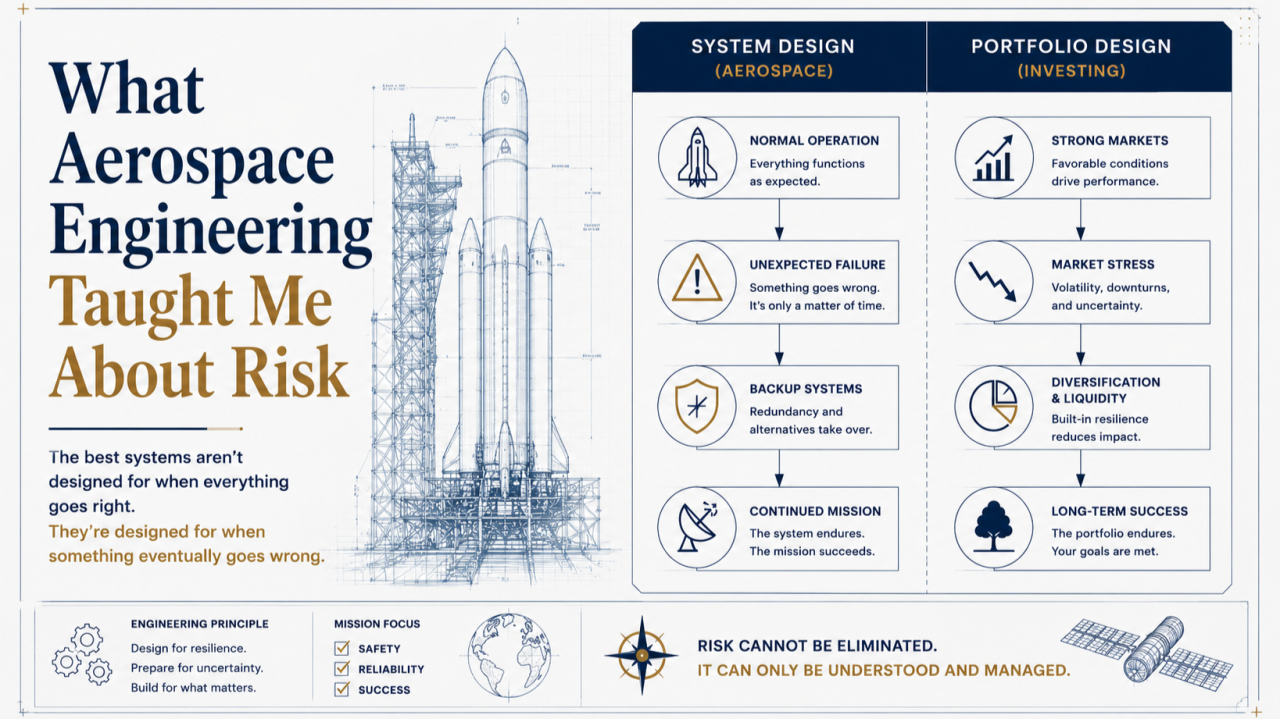
What Aerospace Engineering Taught Me About Risk
Before I worked in investment management, I was an aerospace engineer.
I spent my days thinking about systems where failure was not an option. Every component, every assumption, and every possible point of weakness had to be understood long before a system ever left the ground.
One lesson stayed with me throughout that experience:
The goal was never to eliminate risk.
The goal was to understand it, prepare for it, and design a system strong enough to survive it.
Years later, I realized the exact same principle applies to investing.
Redundancy Is Not Pessimism. It Is Good Design. In aerospace, no critical mission depends on a single component.
There are backup systems, redundant controls, and alternative pathways.
Not because engineers expect something to fail every time, but because they understand that eventually something unexpected will happen.
Investing is no different.
A portfolio that depends on one stock, one industry, one asset class, or one source of income may perform extremely well under the right conditions.
Until those conditions change.
Diversification is not about owning more investments.
It is about making sure one wrong assumption cannot permanently damage your future.
The same reason a spacecraft has backup systems is the reason a portfolio needs diversification.
Stress Testing Before Reality Does It For You Before an aircraft or spacecraft is approved for operation, engineers intentionally expose it to extreme conditions.
High temperatures.
Vibration.
Unexpected failures.
The purpose is simple:
Find the weakness in a controlled environment before the real world finds it for you.
Investors should think the same way.
The question is not:
"What happens if my portfolio earns 10% next year?"
The better questions are:
What happens if markets decline 30%? What happens if inflation remains elevated? What happens if I need cash during a recession? What happens if my assumptions are wrong?
The strongest portfolios are not the ones built for a perfect environment.
They are the ones that can withstand an imperfect one.
A Margin of Safety Creates Freedom Every engineer understands that models are not reality.
A bridge designed to hold 10 tons is not built to collapse at 10.1 tons.
There is a margin of safety.
Investing requires the same humility.
Cash reserves, prudent position sizing, realistic expectations, and avoiding excessive leverage all recognize one simple truth:
The future will not unfold exactly as we expect.
A portfolio that appears mathematically optimal may be the one most vulnerable when reality looks different than the model.
The Goal Is Not Perfection. It Is Resilience. There is a question engineers constantly ask:
"What happens if this fails?"
In my view, it may be one of the most important questions an investor can ask as well.
What happens if your largest investment falls 50%?
What happens if retirement comes during a recession?
What happens if your business experiences a difficult year?
The best systems are not designed for when everything goes right.
They are designed for when something eventually goes wrong.
The same is true for portfolios.
Successful investing is not about predicting every storm.
It is about building a structure capable of surviving the storms you cannot predict.
Because in both aerospace and investing, resilience is not a sign of fear.
It is the foundation of long-term success.