Understanding Market Leadership Across Economic Cycles
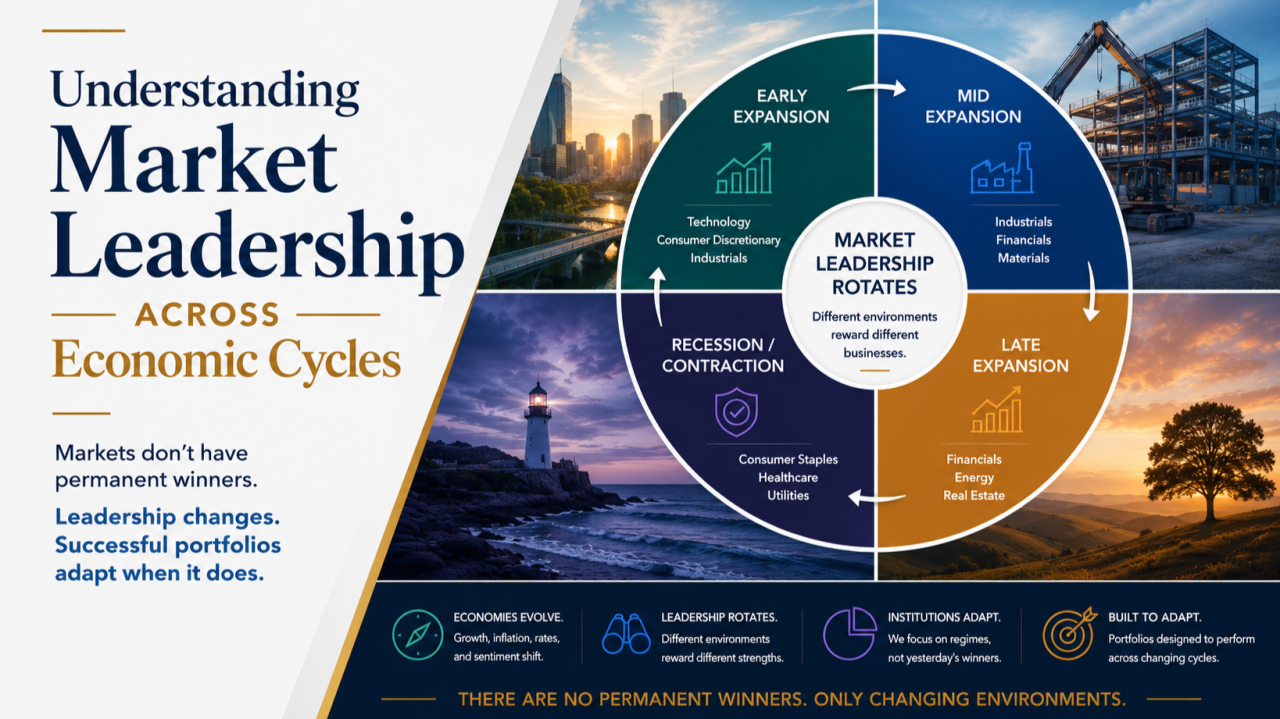
One of the easiest mistakes investors make is assuming that the companies leading the market today will continue leading tomorrow.
It feels logical.
If a business is growing, profitable, and outperforming, why wouldn't it keep doing so?
Because markets don't reward the same characteristics forever.
They reward the businesses best suited for the environment they're operating in.
And environments change.
Running a Business Through Different Economies
Imagine you own a business.
The strategy that works during rapid economic growth probably isn't the same strategy you'd use during a recession.
When customers are spending freely and financing is inexpensive, expanding aggressively may be the right decision.
When borrowing becomes more expensive and demand slows, preserving cash, controlling costs, and focusing on profitability often become much more important.
Neither strategy is universally better.
They're simply designed for different environments.
The stock market works much the same way.
What Market Leadership Really Means
Market leadership simply describes which types of businesses are outperforming at a particular point in time.
Sometimes investors favor fast-growing companies.
Other times they reward businesses with stable cash flows.
Sometimes energy companies lead.
Other times technology or healthcare takes the spotlight.
Leadership changes because the economic backdrop changes.
The important lesson is this:
Markets don't choose permanent winners. They reward businesses that fit the current environment.
Why Leadership Rotates
Economic cycles influence almost every business.
Interest rates change.
Inflation changes.
Consumer confidence changes.
Access to financing changes.
As those conditions evolve, companies experience them differently.
A business built for rapid expansion may thrive when capital is abundant.
A business selling everyday necessities may prove more resilient when consumers become cautious.
Neither company became better overnight.
The environment changed.
How Institutional Investors Think
This is one reason institutional investors spend so much time studying economic regimes.
They're not trying to predict the next headline.
They're asking a different question:
"Which business characteristics are likely to be rewarded if the environment changes?"
That mindset leads to very different portfolio decisions than simply buying whichever companies performed best over the past year.
Professional investors know that yesterday's winners don't automatically become tomorrow's leaders.
Why Diversification Matters
This is also why diversification is about much more than owning many investments.
A well-constructed portfolio holds businesses that respond differently to different economic environments.
Some may benefit from faster growth.
Others may provide resilience during slower periods.
Together, they create a system that can adapt as conditions evolve.
That's intentional.
It's the same principle engineers use when designing systems expected to perform under changing conditions.
Different components serve different purposes.
The Bigger Lesson
Investing isn't about finding one perfect business that wins forever.
It's about recognizing that economies evolve, leadership changes, and portfolios should be designed with that reality in mind.
The best investors don't spend their time asking:
"What was the best investment last year?"
They ask:
"What kind of businesses are best positioned for the environment ahead?"
That's a very different question.
And over time, it often leads to very different decisions.
Because market leadership changes.
Successful portfolios are designed to adapt when it does.