The Financial Structure Every Entrepreneur Eventually Needs
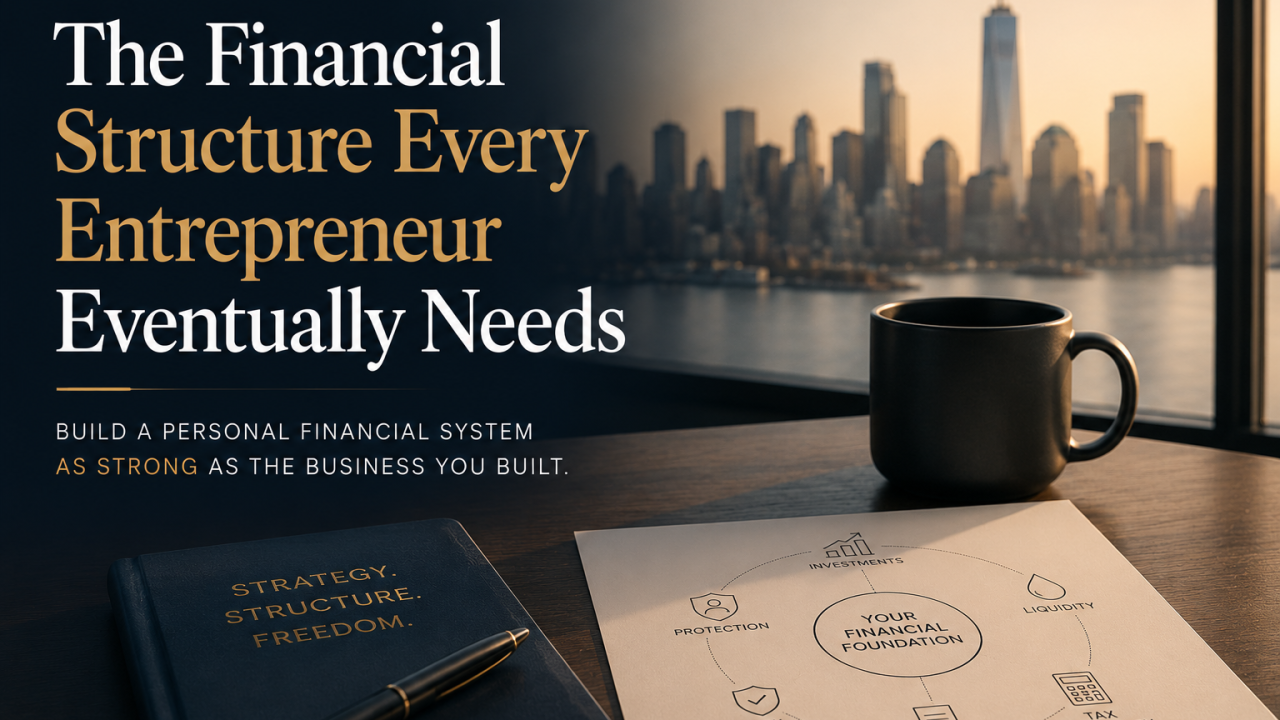
Most successful businesses don't run on good intentions.
They run on structure.
Budgets.
Dashboards.
Operating procedures.
Weekly reviews.
Decision-making frameworks.
Over time, every successful company develops an operating system, a way of making decisions consistently rather than reacting to whatever happens next.
Then something interesting happens.
Many of the entrepreneurs who build these incredibly well-organized businesses manage their personal finances in exactly the opposite way.
Investments accumulate over time.
Cash sits wherever it's convenient.
Old retirement accounts remain untouched.
Real estate gets purchased when opportunities arise.
The business grows.
Personal wealth grows.
But the system never does.
It's not because they're undisciplined.
It's because the business demanded structure long before their personal finances ever did.
Two different systems
Running a business and managing personal wealth are related.
They are not the same system.
A company can have outstanding financial reporting, excellent governance, and disciplined capital allocation while its owner has no clear framework for managing their personal balance sheet.
That difference usually stays hidden.
Until it doesn't.
A liquidity event.
A large tax obligation.
A market correction.
A business transition.
A health event.
Suddenly, questions that were never urgent become unavoidable.
Not because the business failed.
Because the personal financial architecture was never designed to handle them.
Wealth also needs an operating system
One of the biggest lessons from institutional investing is that portfolios aren't managed investment by investment.
They're managed as complete systems.
Every asset has a purpose.
Every dollar has a job.
Every decision is evaluated based on how it affects the portfolio as a whole.
Personal wealth deserves the same approach.
Liquidity isn't simply cash.
It's flexibility.
Diversification isn't about owning more investments.
It's about reducing dependence on any single outcome.
An investment policy isn't about predicting markets.
It's about making important decisions before emotions take over.
Taxes and estate planning aren't annual events.
They're part of the architecture that supports every long-term financial decision.
When these pieces work together, wealth becomes more resilient, not because uncertainty disappears, but because the system is built to handle it.
Why sophisticated families think differently
This is one reason many successful families eventually adopt a family-office mindset.
Not because they want complexity.
But because complexity already exists.
The family office is simply a structured way of coordinating investments, taxes, legal planning, liquidity, and long-term objectives.
It's less about adding moving parts.
It's about making sure the existing ones work together.
The same principle applies regardless of portfolio size.
The goal isn't to build a family office.
It's to build a financial operating system.
One that evolves as life changes.
One that supports better decisions.
One that continues working even when markets, businesses, or circumstances don't.
The bigger picture
Entrepreneurs already know how to build systems.
That's how successful companies are created.
Eventually, the same discipline needs to be applied to personal wealth.
Because building a business is only part of the journey.
Designing the financial structure that protects, supports, and compounds the wealth it creates is the next one.
Building a business requires structure.
Preserving the wealth it creates requires one too.