The Difference Between Economic Growth and Market Performance
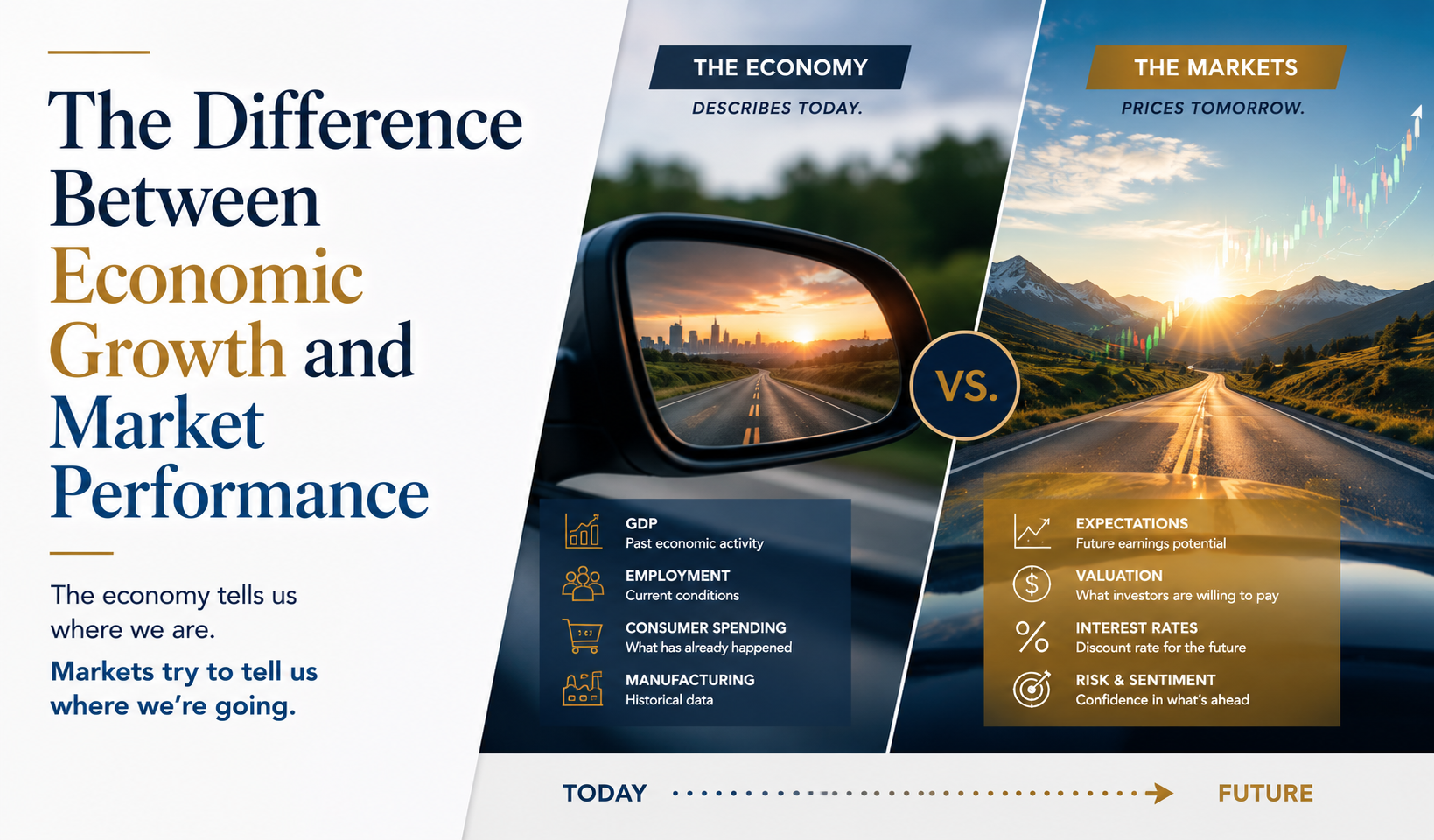
One of the biggest misconceptions in investing is believing that a strong economy automatically leads to a strong stock market.
It seems logical.
Businesses are growing.
Consumers are spending.
Employment is strong.
Surely stocks should be rising too.
Yet history tells a different story.
Some of the market's strongest returns have occurred while economic data looked weak. And some periods of impressive economic growth have delivered disappointing investment returns.
The reason is simple:
The economy and the stock market answer two very different questions.
Looking at the Same Business Differently
Imagine you're thinking about buying a successful private company.
Would you value it based only on last year's revenue?
Probably not.
You'd want to know where the business is headed.
Will profits grow?
Will customers keep buying?
Will margins improve?
What opportunities lie ahead?
The stock market works exactly the same way.
It isn't simply measuring what companies earned yesterday.
It's constantly estimating what they might earn tomorrow.
What GDP Actually Measures
Gross Domestic Product (GDP) measures economic activity that has already taken place.
It captures production, consumer spending, business investment, and government expenditures.
It's one of the best gauges we have for understanding the health of the economy.
But it's also backward-looking.
Think of GDP as your car's rearview mirror.
It tells you exactly where you've been.
What Markets Are Trying to Measure
Markets are looking through the windshield.
Every day, millions of investors reassess what businesses may earn over the coming months and years.
Those expectations are constantly changing as new information arrives.
That's why markets often move long before economic data does.
By the time GDP confirms a slowdown or recovery, investors have usually been adjusting their expectations for months.
Why Expectations Matter More Than Headlines
One lesson institutional investors learn early is this:
Markets don't react to good or bad news. They react to news that is better or worse than expected.
Imagine analysts expect a company to earn $5 per share.
If it reports exactly $5, the stock may barely move.
If it earns $4.90, investors may sell, even though the company remains profitable.
The economy works similarly.
Strong GDP growth that everyone expected may have little impact on markets.
A weaker economy than feared can actually lift stocks if investors begin expecting lower interest rates or a faster recovery.
The surprise often matters more than the headline.
Why Strong Economies Don't Always Produce Strong Markets
Economic growth is only one ingredient in investment returns.
Markets also care about:
- Future earnings
- Interest rates
- Inflation
- Valuation
- Investor expectations
Sometimes a strong economy leads central banks to keep interest rates higher for longer.
Higher borrowing costs reduce what investors are willing to pay for future profits.
The economy may be thriving...
...while markets struggle.
Why Weak Economies Can Produce Strong Markets
The opposite happens too.
Markets frequently recover before economic headlines improve.
Why?
Because investors aren't buying today's economy.
They're buying tomorrow's.
If they believe conditions will improve six to twelve months from now, prices often begin rising well before GDP reflects that recovery.
That's why markets sometimes rally while the news still feels overwhelmingly negative.
Thinking Like an Institution
Institutional investors don't ignore economic data.
They simply recognize its role.
GDP helps explain where the economy has been.
Markets attempt to estimate where businesses are going.
Both matter.
But they answer different questions.
Understanding that distinction changes how you interpret headlines and helps prevent emotional decisions based on yesterday's news.
The next time you hear that "the economy is doing well" or "the economy is struggling," remember this:
That may explain today's environment.
It doesn't necessarily explain today's market.
Because the economy tells us where we are.
Markets are constantly trying to price where we're going.