Teaching the Next Generation About Capital
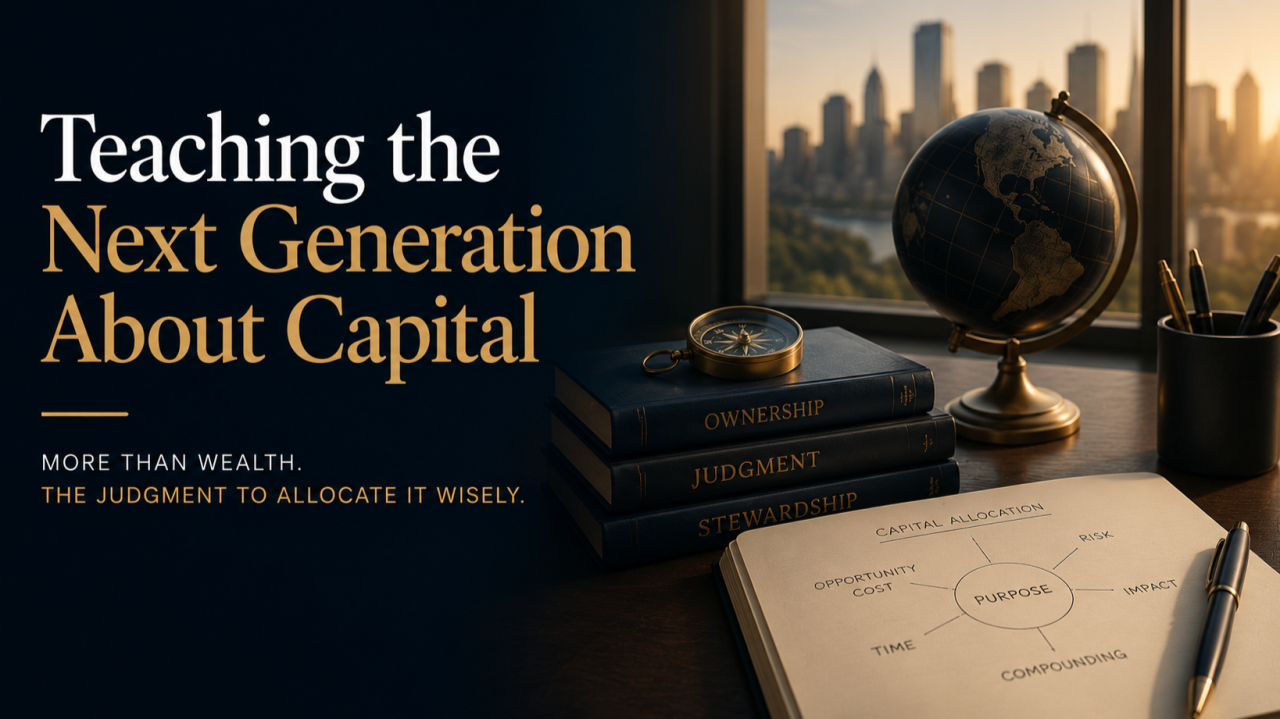
Giving someone capital and teaching someone how to allocate capital are two very different things.
Families can spend decades building businesses, portfolios, and wealth. Eventually, a quieter challenge emerges:
How do you transfer not just the assets, but the judgment required to manage them?
That requires going beyond traditional financial literacy.
Learning how to earn, save, and spend responsibly matters. But those skills primarily teach someone how to manage money.
Capital introduces a different set of questions.
What should this dollar do?
What am I giving up by using it here?
What could happen if I'm wrong?
How long can this capital remain invested?
Does this decision make the overall portfolio stronger or more fragile?
Money teaches transactions. Capital teaches choices.
And perhaps the most important choice begins with understanding opportunity cost.
Every dollar has competing uses.
A dollar invested in a business cannot simultaneously be invested in public markets. Capital used to purchase real estate is no longer available as liquidity. Money spent today gives up whatever that capital might have become tomorrow.
Even holding cash is a choice. It may sacrifice some potential return in exchange for flexibility when a better opportunity appears.
Once someone understands that every financial decision means saying yes to one use of capital and no to another, they're beginning to think like an allocator.
Ownership adds another layer.
Earning income means exchanging effort for compensation. Ownership means participating in the value an asset creates over time while also accepting the uncertainty that comes with it.
That changes the conversation from:
“How much can this make?”
to:
“What can happen if we're wrong?”
How much could be lost?
What else depends on the same outcome?
How quickly could we access the capital if circumstances changed?
Does this investment add something useful to the portfolio, or simply give us more of a risk we already have?
Those questions aren't designed to eliminate risk. Risk is part of investing, entrepreneurship, and wealth creation.
The goal is to understand which risks are being taken, why they're worth taking, and whether the overall financial system can absorb the consequences if things don't go as planned.
There's another lesson that may be even harder to teach.
A good decision can produce a bad outcome.
And a bad decision can sometimes produce a good one.
Imagine evaluating a business carefully, understanding its finances, considering the downside, and making a reasonable investment based on the information available. An unexpected event can still cause that investment to fail.
That doesn't automatically make the original decision foolish.
The opposite is also true. Someone can take an enormous, poorly understood risk and get lucky.
A profitable outcome doesn't automatically make the decision intelligent.
Over time, good capital allocation requires learning to separate decision quality from outcome quality.
That's why judgment is difficult to develop entirely from books.
It grows through participation.
Listening to investment discussions. Comparing two competing opportunities. Researching a company. Evaluating a charitable grant. Managing a limited amount of capital where the decisions actually matter.
The objective isn't to eliminate mistakes.
It's to create an environment where mistakes become lessons while the stakes are still manageable.
This is why sophisticated families increasingly treat next-generation education as part of governance rather than simply inheritance planning.
They're not only asking:
“How do we transfer the wealth?”
They're asking:
“How do we prepare the people who will eventually make decisions about it?”
Future owners, investors, entrepreneurs, trustees, and philanthropists need more than access to capital.
They need experience allocating it.
Because transferring assets is ultimately the easier part.
Capital can be inherited.
Judgment cannot.
Judgment has to be developed through education, experience, responsibility, mistakes, and eventually, real decisions.
The most valuable inheritance may not be the capital itself.
It may be knowing what to do with it.