The Similarities Between Engineering and Portfolio Construction
The Similarities Between Engineering and Portfolio Construction
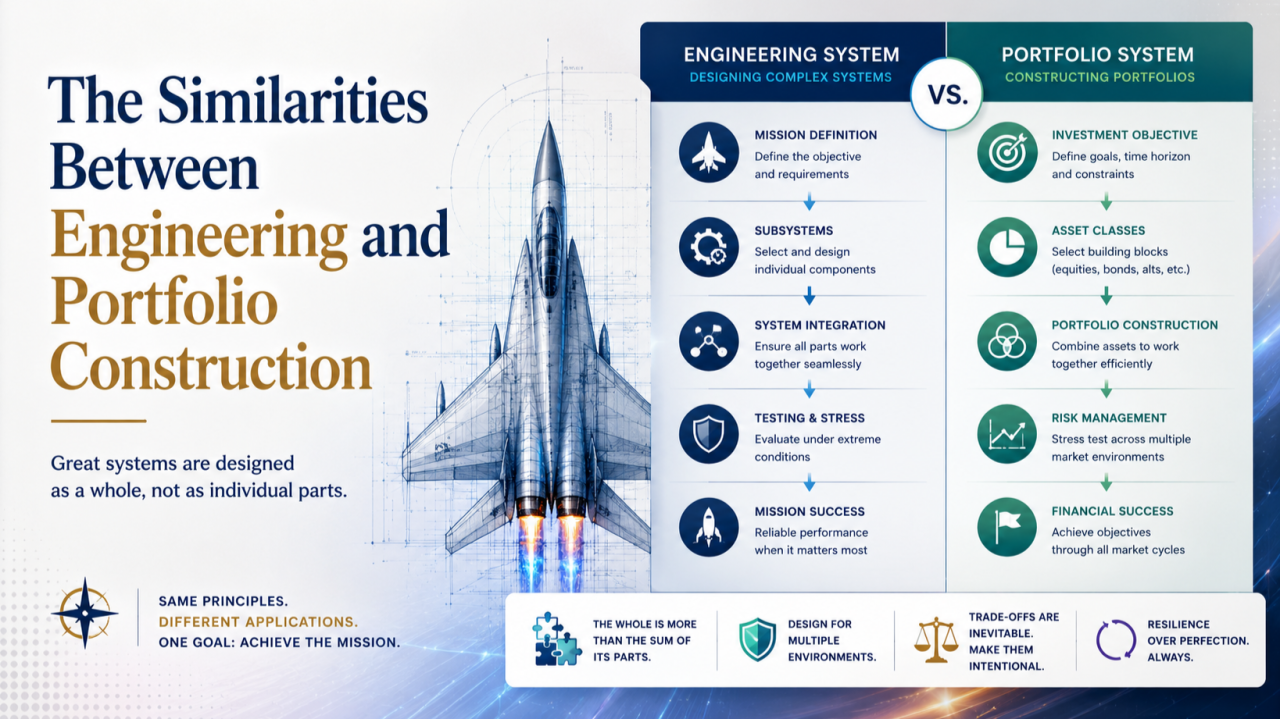
When I worked as a engineer in the Aerospace & Defense industry, one of the most important lessons I learned was that great systems are never built by simply choosing the best individual parts.
The best engine, the strongest material, or the most advanced software means very little if those components cannot work together under pressure.
The real question engineers ask is:
How does the entire system behave when conditions become difficult?
Years later, when I moved into investment management, I realized the same question applies to building a portfolio.
A Portfolio Is a System Many investors spend their time searching for the "best" investment.
The best stock.
The best manager.
The best opportunity.
But a great portfolio is not a collection of great investments.
It is a system of investments designed to work together.
A portfolio filled with excellent individual assets can still fail if all of those assets depend on the same economic outcome.
A group of technology stocks may look diversified because there are many companies involved. But if they all respond similarly to rising interest rates or changing investor sentiment, the portfolio may be more concentrated than it appears.
Just as an engineer studies how parts interact inside a machine, investors must understand how investments interact inside a portfolio.
Designing for Conditions You Cannot Predict Defense systems are not built only for ideal environments.
They are tested against extreme conditions because engineers understand a simple truth:
The real world does not always cooperate.
Investing requires the same humility.
The goal is not to predict whether the next challenge will be inflation, recession, a geopolitical shock, or a market correction.
The goal is to build a portfolio that can navigate many possible environments.
A portfolio designed only for the most likely outcome is not a strategy.
It is a prediction.
Every Advantage Comes with a Trade-Off Engineering teaches another important lesson:
There is no perfect design.
A stronger structure may be heavier.
A faster system may consume more energy.
Improving one characteristic often requires sacrificing another.
Investing follows the same principle.
Higher expected returns may require greater volatility.
Greater liquidity may mean accepting lower returns.
More concentration may create greater upside, but it also increases vulnerability.
Successful investors do not avoid trade-offs.
They make them intentionally.
Reliability Is More Important Than Perfection The most successful engineering systems are not those that look perfect in a laboratory.
They are the ones that continue functioning when the unexpected happens.
A portfolio should be judged the same way.
How does it behave during a recession?
What happens when inflation remains high?
Can it provide liquidity when it is needed most?
Can it continue moving toward its objective when conditions are uncomfortable?
That is what separates a portfolio built for a spreadsheet from one built for real life.
The Lesson That Carried Over My years in engineering taught me that uncertainty is not something you eliminate.
It is something you design around.
The strongest systems acknowledge that failure, surprises, and changing conditions are part of reality.
Investing is no different.
Great portfolios are not defined by the individual strength of their components.
They are defined by how those components work together when the environment changes.
Because the goal was never to build a portfolio that performs perfectly in every market.
The goal is to build one resilient enough to achieve its mission across many different markets.