What Sequence Risk Means for Retirees
What Sequence Risk Means for Retirees
Most people believe retirement success comes down to one thing:
Earning good investment returns.
That seems perfectly logical.
If your portfolio earns 7% a year over the long run, the math should work.
But retirement introduces a challenge that average returns alone can't explain.
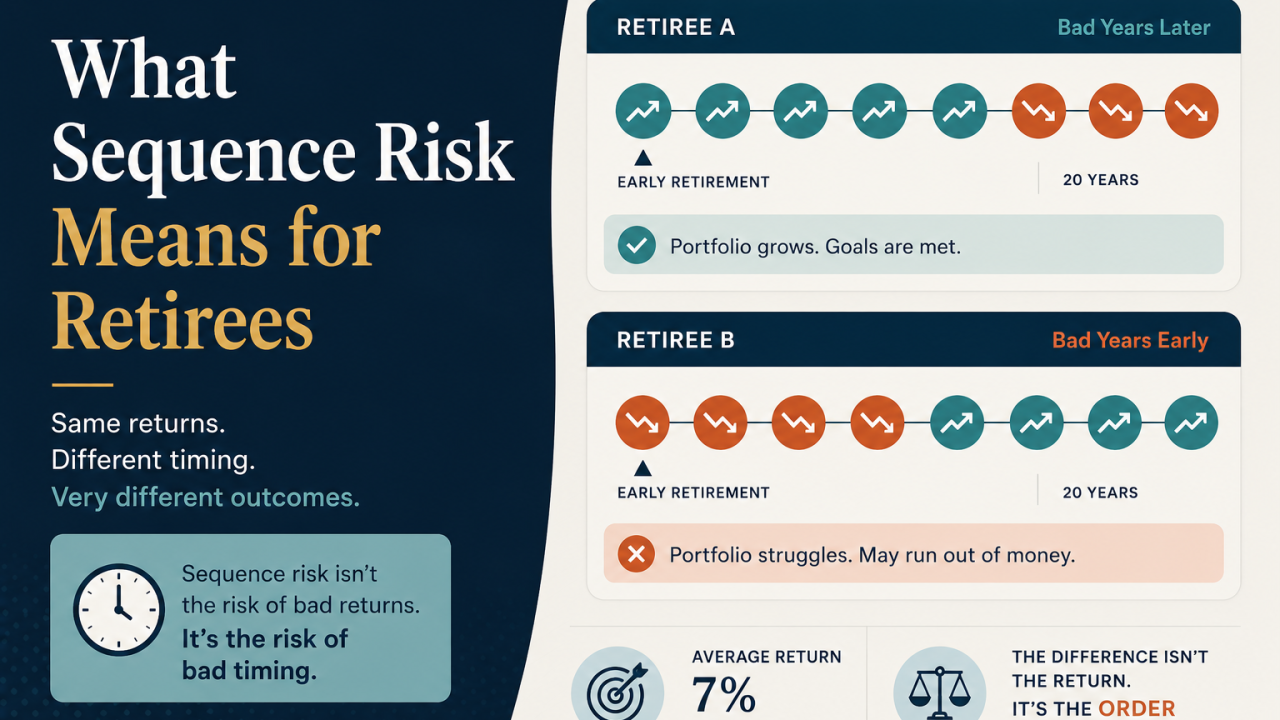
Imagine two retirees.
Both start with the same portfolio. Both earn the exact same average return over the next twenty years.
One leaves a meaningful inheritance.
The other runs out of money.
How is that possible?
Because retirement isn't just about how much the market returns.
It's about when those returns happen.
The Importance of Timing
Think about your working years.
When markets fall, you're usually still saving and investing. In many ways, lower prices can actually help because you're buying more shares.
Retirement flips that equation.
Now you're no longer adding money.
You're taking money out.
If markets decline early in retirement, you may be forced to sell investments at depressed prices to fund your lifestyle. Those shares are gone forever, which means they can no longer participate in the eventual recovery.
Two investors can experience the exact same average return.
But if one faces the bad years first, the outcome can be dramatically different.
That's sequence risk.
Sequence risk isn't the risk of bad returns. It's the risk of bad timing.
A Business Owner Analogy
Imagine two companies.
Both generate the same average profits over twenty years.
One suffers a difficult recession in year two, while carrying significant fixed expenses.
The other experiences that same recession fifteen years later, after building a strong balance sheet.
Same average performance.
Very different outcome.
Retirement works much the same way.
When withdrawals meet market losses early, the portfolio may never fully recover.
Why the Early Years Matter Most
Research from firms like Vanguard, Morningstar, and JPMorgan consistently points to one critical period:
The years immediately before retirement and the first decade after it.
This is often when your portfolio is at its largest, while also beginning to fund your lifestyle.
A major market decline during this window doesn't just reduce wealth.
It can permanently reduce the future earning power of the portfolio itself.
That's why many institutional investors focus less on predicting markets and more on preparing for uncertainty.
How Sophisticated Investors Manage Sequence Risk
The answer isn't abandoning stocks.
Nor is it trying to perfectly time the market.
Instead, institutions often separate long-term investments from short-term spending needs.
Think of retirement like running a business.
You wouldn't fund payroll entirely from long-term projects that fluctuate in value every day.
You would maintain working capital.
Retirement is similar.
Cash reserves, short-term bonds, Social Security, and other reliable income sources can help cover near-term expenses while giving long-term investments time to recover during difficult markets.
The goal isn't to eliminate volatility.
It's to avoid making permanent decisions because of temporary conditions.
The Bigger Lesson
Many people spend decades building wealth.
Far fewer spend time thinking about how that wealth will actually be used.
Retirement isn't simply the accumulation phase continued.
It's a completely different challenge.
One that requires turning assets into reliable cash flow while protecting yourself from bad timing.
The investors who retire most confidently aren't always those with the largest portfolios.
They're often the ones who built a structure that doesn't depend on markets cooperating every single year.
Because ultimately, average returns tell you what may happen over time.
Sequence risk determines whether you have enough time to let those returns work.