Retirement Is About Cash Flow, Not Just Net Worth
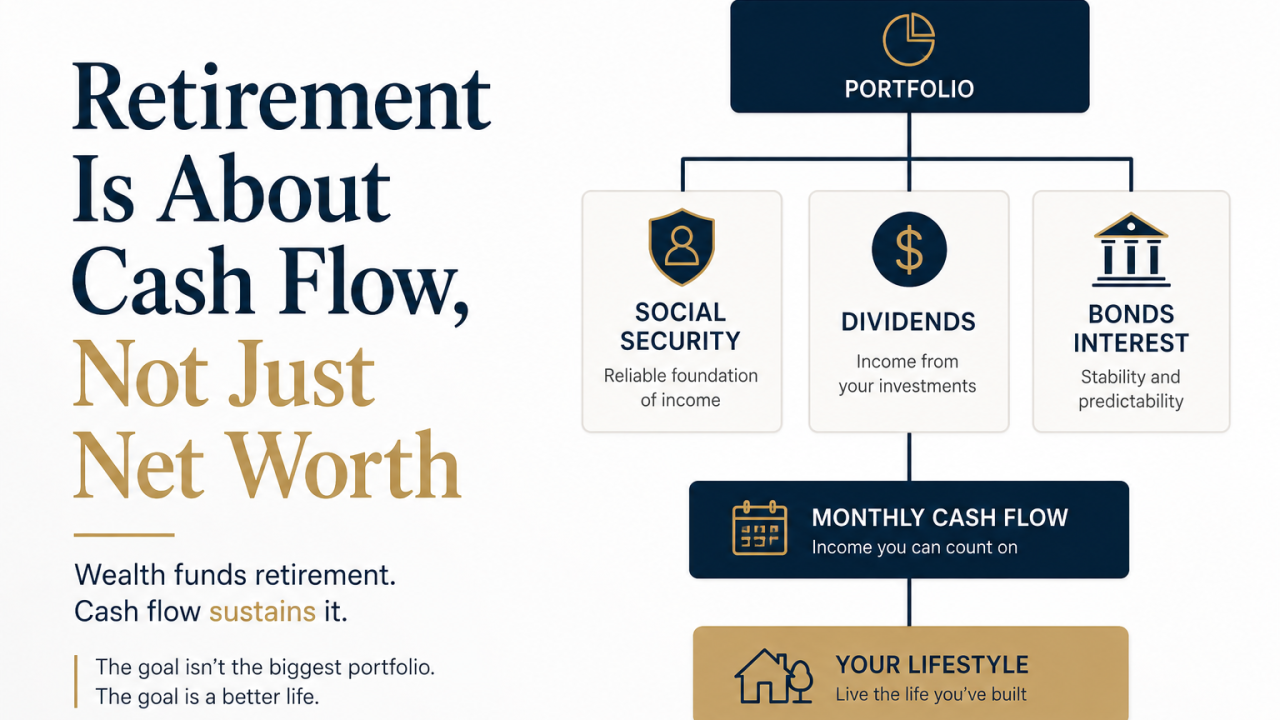
Retirement Is About Cash Flow, Not Just Net Worth
Most people think retirement planning is about reaching a number.
One million dollars. Three million. Five million.
Whatever the target, the assumption is usually the same:
"Once I get there, I'll be financially secure."
But retirement doesn't actually care how much you have.
It cares about how reliably your wealth can produce income.
Because at the end of the day, you don't spend net worth.
You spend cash flow.
Think About It Like a Business
Imagine two companies.
The first owns millions of dollars in assets but struggles to generate consistent revenue.
The second produces steady, predictable cash flow year after year.
Which business would you rather own?
Most people instinctively choose the second.
Retirement works much the same way.
A portfolio isn't simply something you accumulate.
Eventually, it becomes something that has to support your lifestyle.
The Difference Between Wealth and Income
Net worth is a snapshot.
Cash flow is a process.
A successful entrepreneur may have a $5 million business and significant personal investments.
Another retiree may have a smaller portfolio but receive stable income from Social Security, a pension, dividends, and conservative portfolio withdrawals.
Who is more financially secure?
The answer isn't always the person with the larger balance sheet.
Often, it's the person with the more predictable income stream.
That's one reason many institutional investors spend less time obsessing over portfolio size and more time designing sustainable cash flow.
The Risk Most People Never See
One of the biggest challenges in retirement isn't poor investing.
It's bad timing.
Imagine two investors who both earn the exact same long-term return.
One experiences strong markets early in retirement.
The other retires into a difficult market and has to begin selling investments while prices are depressed.
Same average return.
Very different outcome.
That's because retirement isn't simply about growing wealth.
It's about generating income while protecting the assets that still need time to recover and compound.
This is why many sophisticated investors maintain cash reserves and short-term investments alongside their long-term portfolio.
The goal isn't to maximize returns every year.
The goal is to avoid making forced decisions during difficult markets.
How Institutions Think About Retirement
Family offices and institutional investors often approach retirement the same way they would manage a business.
First, they identify essential expenses.
Then they determine which income sources reliably cover those expenses:
- Social Security
- Pensions
- Bond interest
- Dividends
- Rental income
The investment portfolio then becomes a source of additional flexibility rather than the sole engine supporting retirement.
That distinction can dramatically reduce financial stress.
The Bigger Goal
Many people believe retirement planning is about accumulating the biggest possible portfolio.
But the real objective is much simpler.
It's creating enough dependable cash flow to live the life you've spent decades building.
Financial independence isn't a number on a spreadsheet.
It's waking up knowing your lifestyle doesn't depend on what the market happened to do yesterday.
Wealth may get you to retirement.
But cash flow is what allows you to stay there.