How Institutional Investors Think About Duration
Most people hear the word duration and assume it refers to time.
How long a bond lasts.
How long until it's repaid.
Reasonable assumption.
Wrong definition.
Institutional investors think about duration very differently.
To them, duration isn't a measure of time.
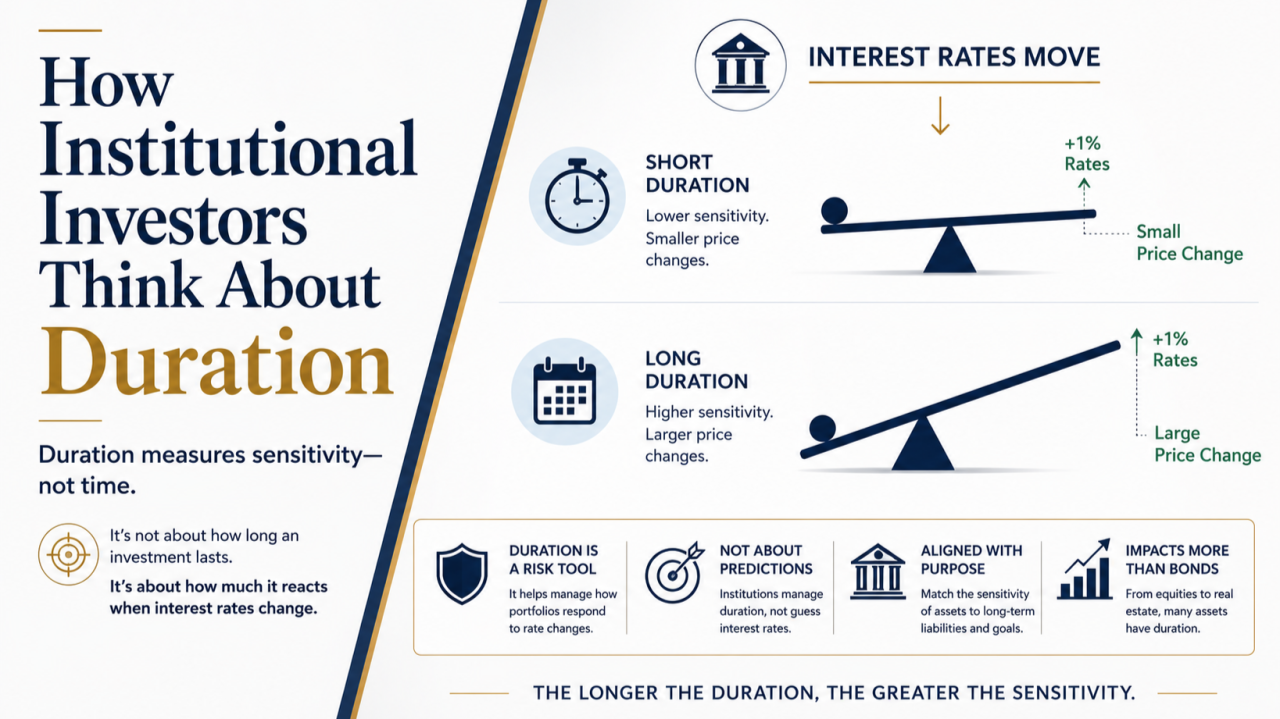
It's a measure of how sensitive an investment is to changes in interest rates.
That distinction changes everything.
Think About Financing a Business
Imagine you're planning to expand your business.
You borrow money to finance a new building.
If interest rates barely affect your financing costs, your business isn't very sensitive to changing rates.
If a small increase in rates dramatically changes your monthly payments, your business becomes much more sensitive.
Nothing about the building changed.
Only the cost of money did.
Duration works much the same way.
It's a measure of how much an investment reacts when interest rates move.
The Lever Analogy
Picture holding a lever.
A short lever barely moves when you apply pressure.
A long lever swings much farther from the exact same push.
Duration works the same way.
When interest rates move a little...
Short-duration investments tend to move only a little.
Long-duration investments tend to move much more.
The longer the duration, the greater the sensitivity.
That's why institutional investors often think of duration as a risk dial, not a clock.
Why Future Cash Flows Matter
Here's the intuition.
Imagine someone promises to pay you $100 tomorrow.
Now imagine someone promises to pay you the same $100 twenty years from now.
Which payment is more affected if interest rates suddenly rise?
The one twenty years away.
Because the further into the future your cash flows sit, the more today's value changes as interest rates change.
That's the foundation of duration.
It's less about when you receive your money.
It's more about how exposed those future cash flows are to changes in the cost of capital.
Why Institutions Manage Duration
Institutional investors don't manage duration because they're trying to predict the next interest-rate decision.
They manage it because every portfolio has a purpose.
A pension fund making payments decades into the future needs investments that behave similarly to those future obligations.
An insurance company has different liabilities.
An endowment has different spending needs.
Managing duration helps align investments with those long-term responsibilities.
It's about matching risk to purpose, not making bold forecasts.
Duration Exists Beyond Bonds
One of the most interesting lessons is that duration isn't limited to fixed income.
Many fast-growing companies generate most of their expected profits years into the future.
That makes them more sensitive to changes in interest rates.
Businesses producing steady cash flows today often behave differently.
Real estate can be affected.
Private equity can be affected.
Even infrastructure assets can exhibit duration-like characteristics.
Once you understand duration, you begin to recognize it across many parts of investing, not just in bond portfolios.
The Bigger Lesson
Institutional investors don't view duration as a technical bond concept.
They view it as a way to understand risk.
Because every investment reacts differently when the cost of money changes.
The question isn't simply:
"How long will I own this investment?"
The better question is:
"How much will this investment react if interest rates change?"
That's what duration measures.
And once you understand that...
You start seeing markets through a very different lens.