The Hidden Importance of Treasury Auctions
The Hidden Importance of Treasury Auctions
Most investors never pay attention to Treasury auctions.
That's understandable. They aren't televised like Federal Reserve meetings, and they rarely make front-page headlines.
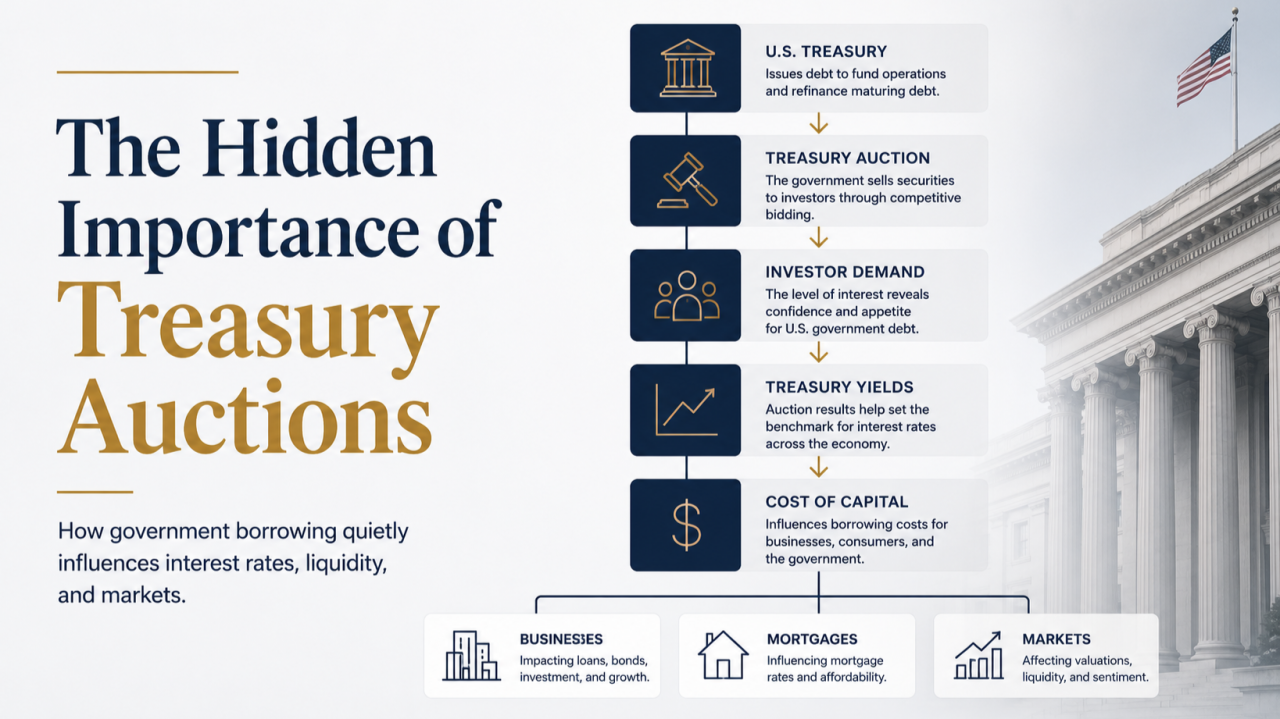
Yet several times each month, the U.S. government borrows hundreds of billions of dollars from investors and the outcome quietly influences everything from mortgage rates and business loans to corporate borrowing costs and stock valuations.
Institutional investors know this.
That's why Treasury auction days are watched so closely.
The World's Largest Borrower Imagine your business needs to raise money.
If banks and investors compete to lend to you, borrowing becomes cheaper.
If very few lenders show up, you'll probably have to offer a higher interest rate to attract capital.
Treasury auctions work exactly the same way.
The only difference is the borrower isn't a company.
It's the United States government.
Several times each month, the Treasury issues bills, notes, and bonds to investors around the world. Some of that borrowing finances new spending, but a significant portion simply refinances debt that's already maturing, much like a business replacing an old loan with a new one.
What Investors Are Really Watching At first glance, Treasury auctions look surprisingly simple.
The government announces how much debt it wants to sell.
Investors submit bids.
The auction determines the yield needed to attract enough buyers.
But beneath that simple process lies one of the clearest measures of investor confidence available anywhere in financial markets.
Professionals aren't just asking:
"Did the auction succeed?"
They're asking:
"How eager were investors to lend money?"
That's where metrics like the bid-to-cover ratio, participation from foreign buyers, and the final auction yield become so important.
These numbers tell us whether investors are lining up to buy U.S. government debt or demanding higher compensation before they're willing to lend.
Why Strong and Weak Auctions Matter A strong auction usually means demand exceeded expectations.
Investors were comfortable lending money at current yields.
A weak auction tells a different story.
Buyers require higher yields before committing their capital.
That may sound like a small detail inside the bond market.
It isn't.
Treasury securities serve as the foundation for borrowing costs throughout the financial system.
When Treasury yields rise, banks often charge more for mortgages.
Companies may pay more to issue bonds.
Business loans become more expensive.
Even stock valuations can adjust because investors compare future returns against higher "risk-free" yields.
One auction can influence the price of money across the entire economy.
Why Institutional Investors Pay Attention This is why firms like JPMorgan, BlackRock, PIMCO, and Goldman Sachs monitor Treasury auctions so closely.
They're not watching because they're fascinated by government debt.
They're watching because Treasury auctions provide a real-time snapshot of liquidity, investor confidence, and the cost of capital.
Unlike headlines or opinions, auctions reveal what investors are actually willing to do with their money.
And markets tend to trust actions more than words.
The Bigger Lesson Most people think interest rates begin with the Federal Reserve.
In reality, the cost of money is shaped every day by millions of investors deciding where to allocate their capital.
Treasury auctions are one of the clearest windows into that process.
They don't just determine how the U.S. government borrows.
They influence how businesses expand, how families finance homes, and how investors value nearly every other asset.
The next time you hear about a Treasury auction, don't think of it as another government event.
Think of it as one of the market's most honest conversations about the price of capital.