Most Entrepreneurs Are Overexposed to One Asset
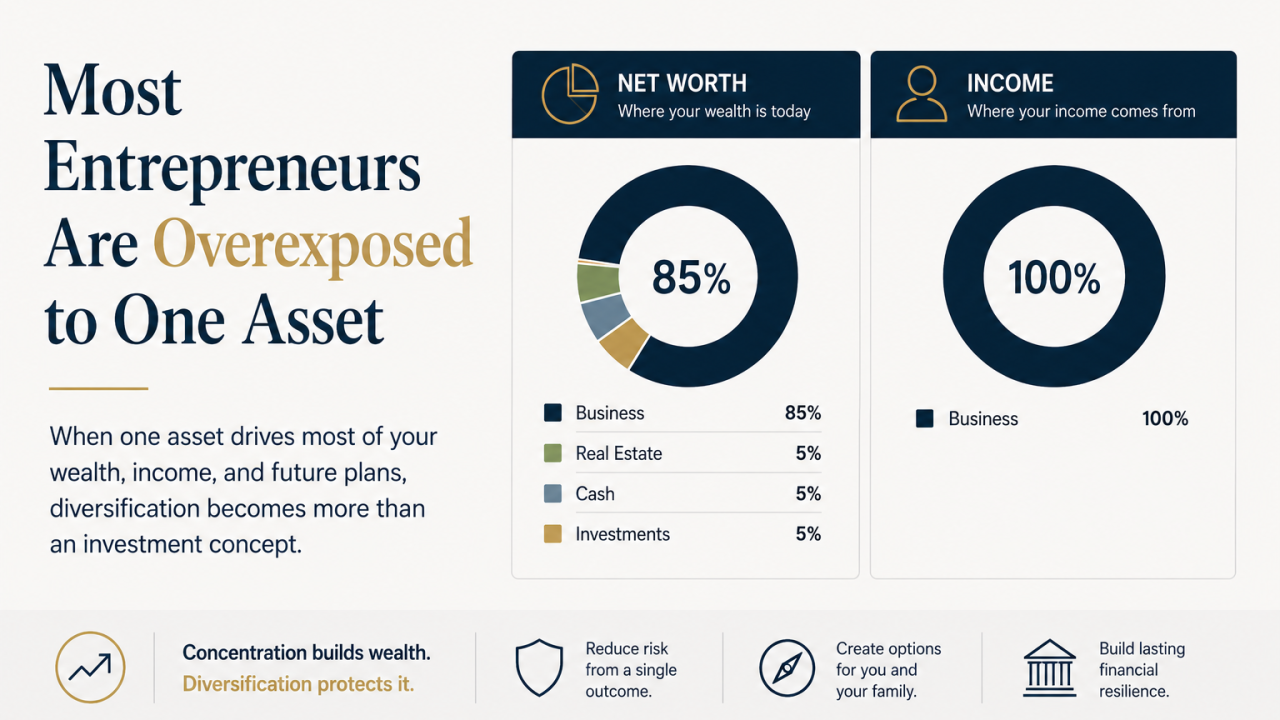
Most Entrepreneurs Are Overexposed to One Asset
Ask a successful entrepreneur what their largest investment is, and most won't hesitate to answer.
Their business.
What many don't realize is that the business is often much more than their largest investment.
It's also:
- Their primary source of income
- Their retirement plan
- Their future liquidity event
- Their family's financial security
In other words, a single asset is often doing a lot of heavy lifting.
And that creates a level of concentration risk that would make most professional investors uncomfortable.
The Diversification Rule Many Entrepreneurs Ignore
Most business owners understand diversification when it comes to investing.
They wouldn't put 100% of their portfolio into a single stock.
Yet many have 70%, 80%, or even 90% of their net worth tied to one private company.
The irony is hard to miss.
The same person who carefully diversifies their brokerage account may have nearly their entire financial future dependent on one business, one industry, one customer base, and one economic outcome.
That's not necessarily wrong.
In fact, concentration is often how wealth gets created.
But it's important to recognize it for what it is.
A concentrated bet.
The Risk Isn't Just the Business
The concentration goes deeper than most people realize.
Imagine a business owner whose company is worth $10 million.
On paper, they appear wealthy.
But what happens if:
- A major customer leaves?
- The industry enters a downturn?
- A health issue forces them to step away?
- An expected sale gets delayed?
Suddenly, the same asset driving their net worth is also affecting their income, liquidity, and future plans.
This is why entrepreneurs often face a unique challenge.
Their wealth, cash flow, and human capital are frequently tied to the same source.
When one area is affected, everything else can feel it too.
The Difference Between Wealth and Liquidity
One of the most overlooked risks for entrepreneurs is liquidity.
A public stock can be sold tomorrow.
A privately held business usually can't.
A founder may have a net worth measured in millions while still having limited access to cash if an unexpected need arises.
That doesn't make the business less valuable.
It simply means that paper wealth and usable wealth are not always the same thing.
For many entrepreneurs, maintaining meaningful liquidity outside the business isn't pessimism.
It's preparation.
Why Success Can Increase Concentration
Here's the counterintuitive part.
As a business becomes more successful, concentration risk often increases.
The company grows.
Its value rises.
And over time it can become an even larger percentage of total net worth.
Many entrepreneurs assume greater success automatically creates greater financial security.
Sometimes it simply creates greater dependence on a single asset.
That's why many family offices and institutional advisors begin discussing diversification long before a sale is on the horizon.
Not because they want the owner to abandon the business.
But because they want to create options.
The Real Goal
This isn't an argument against entrepreneurship.
Far from it.
Most significant wealth is created through concentration.
The challenge is knowing when to begin protecting what has already been built.
The goal isn't maximum diversification.
The goal is financial resilience.
Enough liquidity to handle surprises.
Enough flexibility to make decisions from a position of strength.
Enough independence that one event doesn't determine every financial outcome.
Because ultimately, diversification isn't about reducing ambition.
It's about reducing dependence.
And for many entrepreneurs, that's a distinction worth thinking about long before an exit becomes part of the conversation.