The Energy Demands of Artificial Intelligence
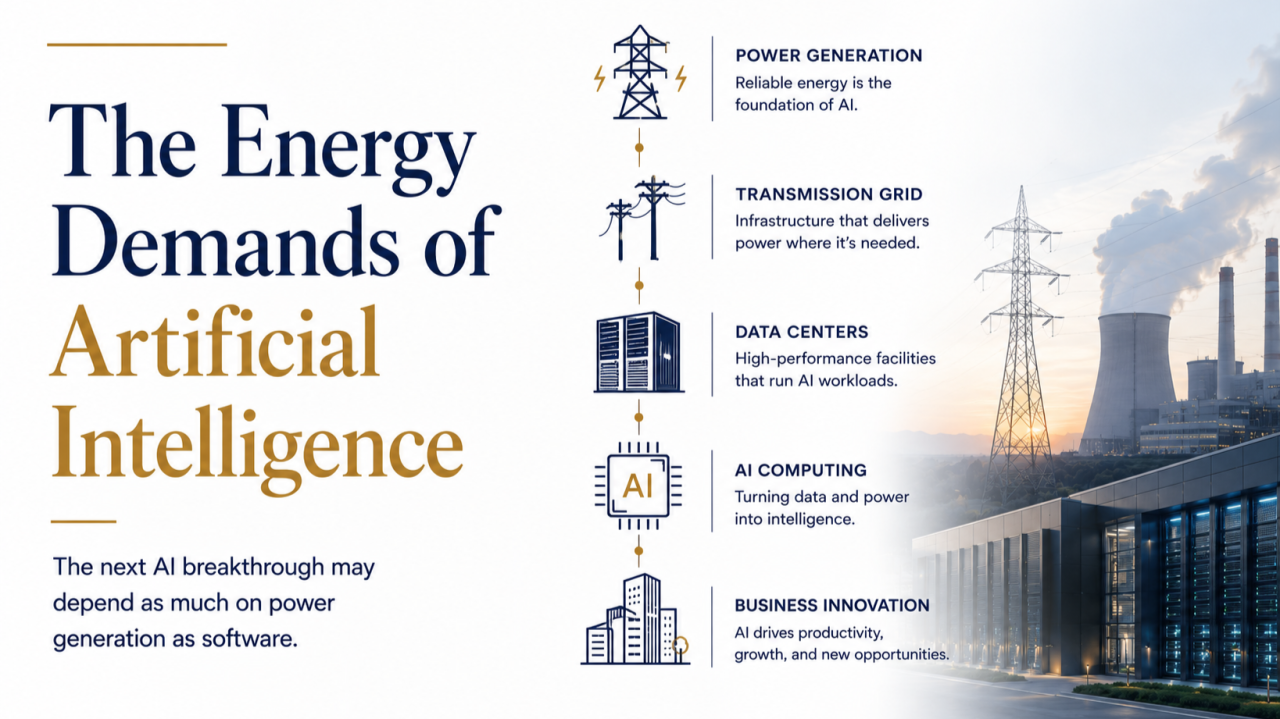
The Energy Demands of Artificial Intelligence
When most people think about artificial intelligence, they think about software.
Smarter models.
Faster answers.
New capabilities.
But spend time talking with institutional investors, utility executives, or infrastructure specialists, and you'll notice the conversation quickly shifts.
They aren't asking:
"How smart will AI become?"
They're asking:
"Can we generate enough electricity to power it?"
That may sound surprising.
But it's becoming one of the most important questions behind the entire AI revolution.
AI Doesn't Just Need Better Software Imagine opening a manufacturing plant.
The building is finished.
The equipment has arrived.
Your employees are ready.
Then someone tells you the power grid can't supply enough electricity to operate the facility.
The problem isn't the factory.
It's powering the factory.
Artificial intelligence faces a similar challenge.
Every conversation with an AI model is processed inside massive data centers filled with thousands of specialized computer chips.
Those chips consume enormous amounts of electricity and generate equally enormous amounts of heat that must be removed continuously.
Without reliable power, AI simply stops.
Why Electricity Has Become the Constraint Traditional computing grew steadily over decades.
Artificial intelligence has changed that pace entirely.
Large AI models require dramatically more computing power than previous generations of software, pushing electricity demand to levels utilities never anticipated.
The International Energy Agency expects electricity consumption from data centers to more than double by 2030, with AI accounting for much of that growth.
That isn't just more demand.
It's an entirely new source of demand.
The challenge isn't building another data center.
It's delivering enough electricity to operate it, every hour of every day.
Power Is Becoming Strategic Infrastructure This is why the AI conversation has expanded far beyond software companies.
Today, discussions increasingly include:
electric utilities, transmission networks, substations, transformers, cooling systems, and power generation.
In many regions, the limiting factor is no longer land.
It's access to electricity.
A company may have the capital to build another data center.
But if sufficient power isn't available, the project may never move forward.
That's a very different investment story than most people expected when AI first captured the world's attention.
Why Institutional Investors Are Looking Beyond Technology One of the biggest shifts happening today is how institutional investors define the AI opportunity.
Instead of asking only:
"Who builds the best AI model?"
They're asking:
Who generates the electricity? Who expands the transmission grid? Who builds the data centers? Who provides the cooling equipment? Who finances the infrastructure?
In other words, they're looking beyond software to the physical systems that make software possible.
History offers plenty of examples.
The Industrial Revolution depended on railroads and electricity.
The internet depended on fiber-optic networks.
Artificial intelligence depends on abundant, reliable energy.
Every technological revolution eventually becomes an infrastructure story.
The Bigger Picture Artificial intelligence will continue making headlines because of what it can do.
But its future may be shaped just as much by something far less glamorous:
Electricity.
Because intelligence alone isn't enough.
It also needs power.
The next time someone talks about AI, remember this:
Software may be the innovation.
Energy is what allows that innovation to scale.
And that's why electricity has quietly become one of the most strategic assets of the AI era.
ional lens.