Diversification Is About Risk, Not Quantity
Diversification Is About Risk, Not Quantity
One of the most common misconceptions in investing is the belief that owning more investments automatically makes a portfolio safer.
It doesn't.
You can own 50 stocks and still be heavily concentrated.
You can own 8 investments and be genuinely diversified.
The difference isn't quantity.
It's risk.
Consider a portfolio made up entirely of large technology companies.
Microsoft. Apple. NVIDIA. Amazon. Alphabet.
Five great businesses.
But if interest rates rise sharply, economic growth slows, or investor sentiment shifts away from growth stocks, those positions may all face pressure at the same time.
While there are multiple holdings, there may only be one underlying bet.
That's where diversification is often misunderstood.
True diversification isn't about how many investments you own.
It's about owning investments that respond differently when conditions change.
Think about a business owner.
Would you rather have one customer representing 90% of your revenue, or five customers from different industries with different needs?
Most business owners intuitively understand the answer.
The goal isn't to have more customers.
The goal is to avoid depending on a single outcome.
Investing works much the same way.
Institutional investors spend surprisingly little time asking: "What should we buy next?"
Instead, they spend significant time asking: "Where are our risks concentrated?"
Pension funds, endowments, and large institutions don't build portfolios around predictions alone.
They build portfolios around balance.
Different asset classes tend to respond differently to: 📈 Economic growth 📉 Recessions 💰 Inflation 🏦 Interest rates 🌎 Geopolitical events
That diversity of behavior is often more important than the number of positions in the portfolio.
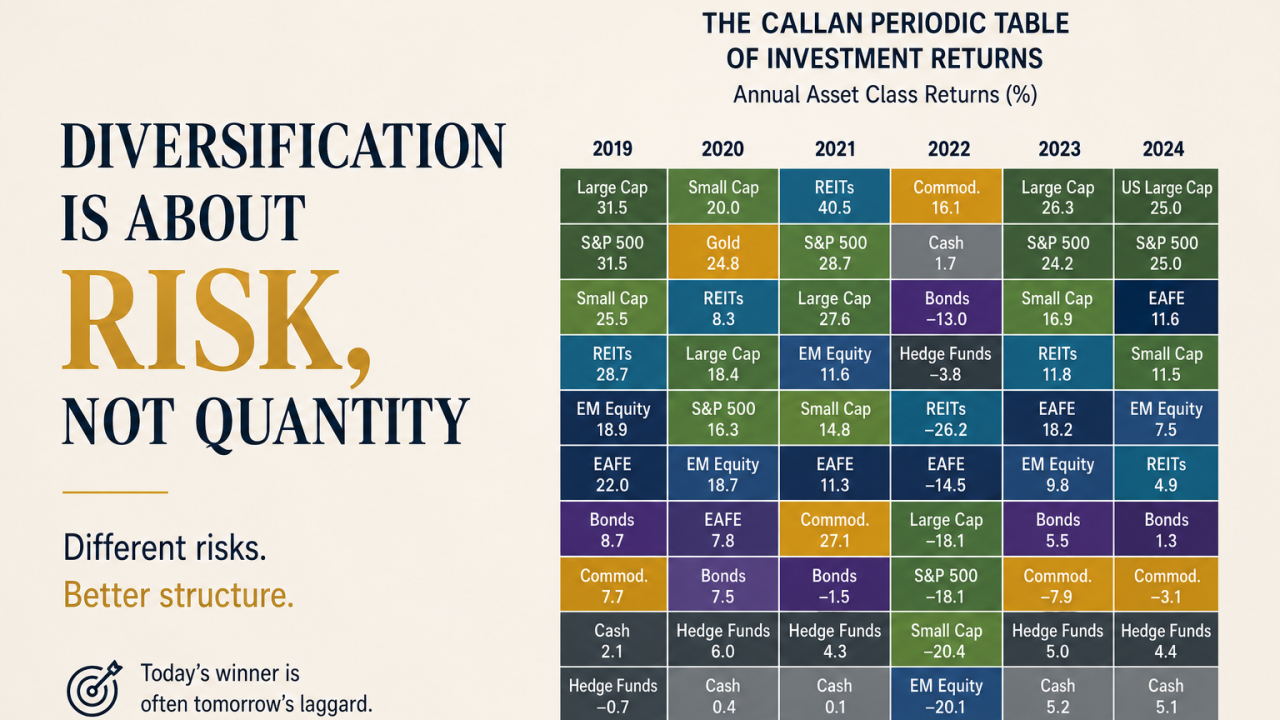
One reason diversification remains so powerful is that market leadership constantly changes.
The asset class that performs best one year is often nowhere near the top the following year.
This is clearly illustrated by the Callan Periodic Table of Investment Returns, which shows how difficult it is to consistently predict tomorrow's winners.
Rather than trying to guess correctly every year, diversified portfolios are designed to participate across a range of possible outcomes.
That doesn't eliminate risk.
Nothing does.
In fact, during periods of market stress, many assets can become more correlated than investors expect.
But diversification can reduce dependence on any single company, sector, asset class, or economic scenario.
And over long periods of time, that matters.
The goal of diversification is not to maximize returns in every environment.
The goal is to avoid needing one specific outcome to succeed.
Because markets have a habit of surprising even the smartest investors.
A portfolio is not simply a collection of investments.
It is a collection of risks.
And understanding that distinction is often where better portfolio construction begins.