What Credit Spreads Are Signaling Right Now
What Credit Spreads Are Signaling Right Now
Most investors spend their time watching the stock market.
Institutional investors also spend a lot of time watching the credit market.
Why?
Because credit markets tend to reveal changes in financial conditions before they fully show up elsewhere.
They offer a real-time look into: investor confidence, risk appetite, borrowing conditions, or liquidity across the system.
And right now, they are telling an interesting story.
So what exactly is a credit spread?
When companies borrow money through bonds, investors demand a higher return than they would receive from U.S. Treasuries.
That extra compensation is called the credit spread.
Think of it as the market’s pricing mechanism for risk.
If investors feel comfortable with economic conditions and corporate balance sheets, spreads usually remain tight.
If stress begins building beneath the surface, spreads tend to widen as investors demand more compensation for taking risk.
That is why institutional investors monitor them so closely.
📌 Tight spreads usually reflect confidence and healthy market functioning.
📌 Widening spreads can signal rising caution, tighter financing conditions, or growing concern around credit quality.
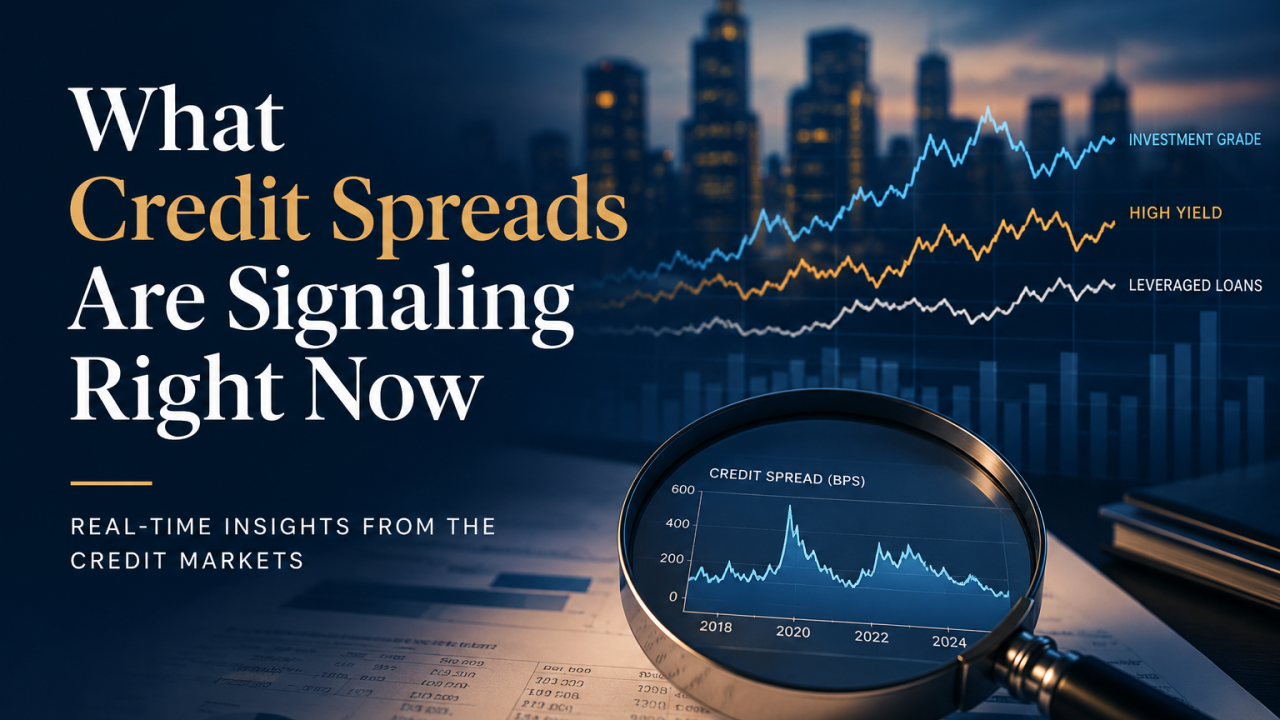
Today, spreads remain relatively tight by historical standards.
On the surface, that suggests markets are still comfortable taking risk and that financing conditions remain orderly for most companies.
But there is an important nuance here.
Even though spreads are relatively calm, the overall cost of borrowing is still much higher than it was during the ultra-low-rate environment of the last decade.
That matters.
A company refinancing debt today is facing a very different environment than it would have a few years ago, even if spreads themselves look stable.
In other words:
Markets are not necessarily saying “everything is great.”
They may simply be saying: 👉 “Nothing is breaking yet.”
That distinction is important for long-term investors.
This is also why many institutional investors today are becoming more selective.
The focus is shifting away from simply chasing the highest yield and toward questions like:
- Which businesses have durable cash flows?
- Which balance sheets can handle higher financing costs?
- Which companies may struggle refinancing debt over time?
Credit markets rarely attract the same attention as equities.
But they often provide one of the clearest windows into how much stress or confidence exists beneath the surface of the financial system.
And sometimes, what matters most in markets is not what headlines are saying today…
…but what credit markets are quietly signaling underneath.
FinancialQ Group — Institutional portfolio thinking for long-term investors.