Why Business Owners Need Liquidity Planning
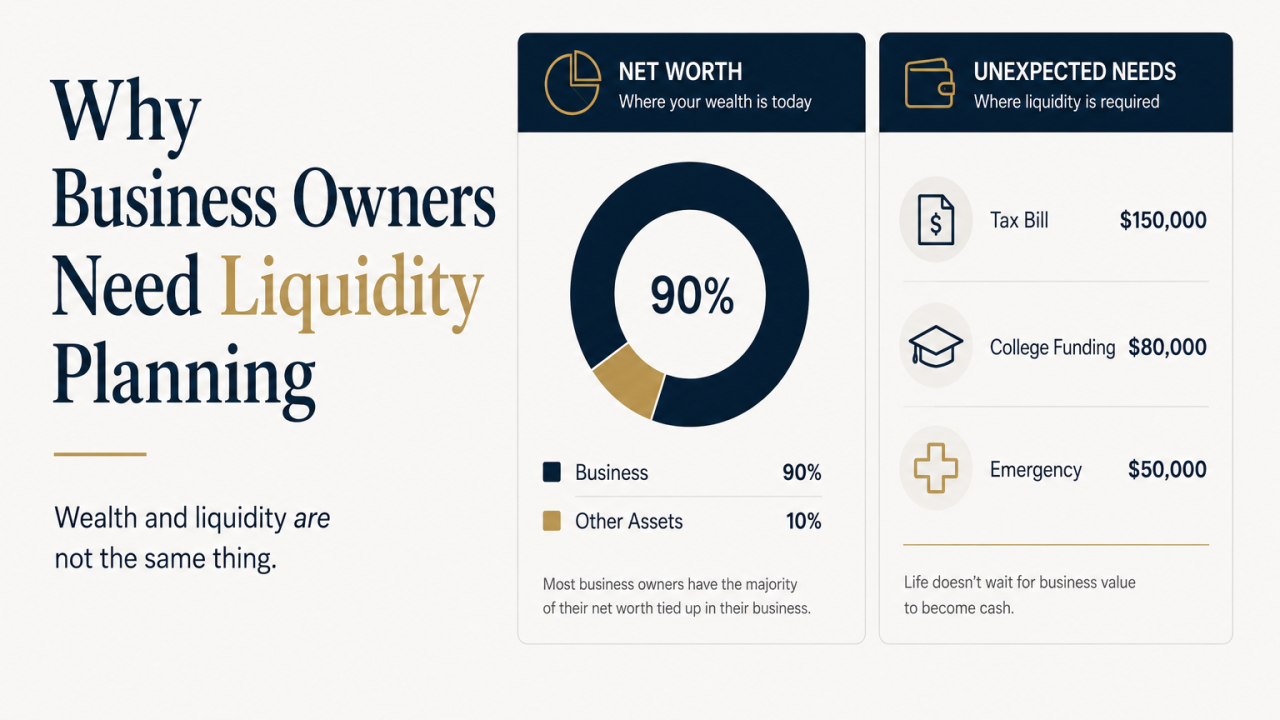
Why Business Owners Need Liquidity Planning
Imagine your business is worth $10 million.
Would you be able to access $500,000 in cash within the next 30 days if you needed it?
For many business owners, that's a surprisingly difficult question to answer.
And that's exactly why liquidity planning matters.
Wealth and Liquidity Are Not the Same Thing
One of the biggest misconceptions in personal finance is assuming that wealth and liquidity are interchangeable.
They're not.
Wealth is what you own.
Liquidity is what you can access.
A business owner may have a substantial net worth on paper, yet still face challenges coming up with cash when it is needed most.
The business may be valuable.
The equity may be real.
But neither automatically solves a short-term liquidity need.
That's because a privately held business isn't a savings account.
You can't simply sell 5% of it next Tuesday to cover an unexpected expense.
Why This Matters More Than Many Entrepreneurs Realize
Business owners face a unique challenge.
Their income, net worth, and future financial plans are often tied to the same asset.
The business.
That works exceptionally well when things are going right.
But life rarely operates on a perfect schedule.
Consider a few common situations:
- A large tax payment arrives sooner than expected
- A family emergency requires significant cash
- A business opportunity appears and requires quick capital
- A key employee needs a retention package
- An acquisition opportunity presents itself with a short deadline
None of these situations care what your business is worth.
They require liquidity.
And liquidity operates on a different timeline than business value.
The Difference Between Being Wealthy and Being Flexible
One way to think about liquidity is this:
Liquidity creates options.
Business owners with adequate liquidity have the ability to make decisions from a position of strength.
They can:
- ✓ Walk away from a low acquisition offer
- ✓ Invest in opportunities when competitors pull back
- ✓ Navigate periods of uncertainty without feeling forced into difficult decisions
- ✓ Support personal and family goals without disrupting the business
This is one reason family offices and institutional investors place such a high value on liquidity planning.
They don't view liquidity as idle cash.
They view it as strategic flexibility.
A Practical Framework
The goal isn't to maximize cash balances.
Excess cash carries its own opportunity cost.
The goal is to ensure that your financial structure matches your real-world obligations.
A useful starting point is asking three simple questions:
- How much liquidity would I need if my business experienced a difficult year?
- How much liquidity would I need if an unexpected personal event occurred?
- How much liquidity would I want available if a compelling opportunity appeared tomorrow?
Many business owners have spent years building valuable businesses.
Far fewer have spent time determining how much liquidity they need outside of those businesses.
That distinction matters.
The Bigger Picture
Liquidity planning isn't about expecting the worst.
It's about creating flexibility.
Because the reality is that opportunities, obligations, and unexpected events rarely arrive on our preferred timeline.
The entrepreneurs who navigate those moments best are often not the wealthiest.
They're the ones with the most options.
And in many cases, liquidity is what creates those options.