Why Asset Allocation Matters More Than Stock Selection
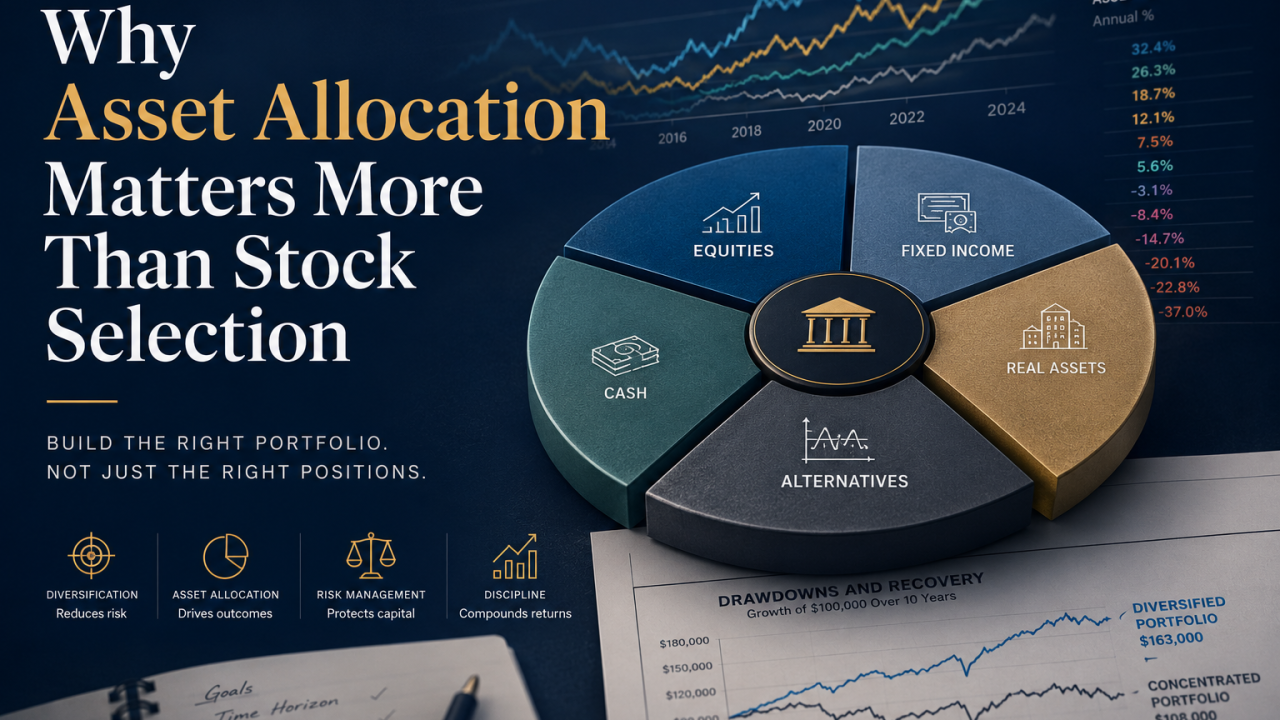
Why Asset Allocation Matters More Than Stock Selection
Most investors spend a lot of time asking:
“What stock should I buy next?”
Institutional investors often ask a different question first:
“How should the portfolio be structured?”
That distinction matters more than many realize.
Because over long periods of time, portfolio structure often has a bigger impact on outcomes than any individual investment decision.
Think about it this way:
Owning a great stock inside a poorly structured portfolio is a little like having a high-performance engine inside a car with weak brakes and poor suspension.
The individual component may be excellent.
But the overall system still matters more.
That is the role of asset allocation.
At its core, asset allocation is simply deciding:
- How much risk to take
- Where that risk should come from
- And how different investments work together inside a portfolio
This is why large institutions like pension funds and endowments spend enormous amounts of time thinking about diversification, correlations, and portfolio balance and not just individual stock ideas.
Because true diversification is not about owning “a lot of things.”
It is about owning assets that behave differently.
If everything in a portfolio falls together during periods of stress, the portfolio may not actually be diversified at all.
This becomes especially important during market volatility.
Historically, leadership rotates constantly across:
- 📈 U.S. stocks
- 🌎 International markets
- 🏢 Real assets
- 💵 Bonds
- ⚡ Different sectors and industries
One of the clearest examples of this is the Callan Periodic Table of Investment Returns, which visually shows how difficult it is to consistently predict winning asset classes year after year.
That unpredictability is exactly why diversification matters.
Strong portfolios are rarely built around prediction alone.
They are built around preparation.
That also explains why rebalancing matters.
Over time, markets naturally push portfolios out of alignment as certain assets outperform others. Rebalancing helps restore discipline by gradually reducing exposure to what has run the most and adding to areas that may have lagged.
In many ways, allocation is less about maximizing excitement…
…and more about improving resilience.
The best portfolios are not always the ones with the highest short-term returns.
They are often the ones designed to:
- Survive difficult periods
- Compound steadily over time
- And allow investors to stay disciplined through full market cycles
Markets will always reward great companies and strong investment ideas.
But over long horizons, structure often matters more than prediction.
A portfolio is not simply a collection of investments.
It is a system.
And for many sophisticated investors, that system becomes the strategy itself.